Office Heater Costs and Options for 2026
A data-driven guide to choosing, sizing, and operating an office heater. Learn about types, costs, ROI, safety, and budgeting for 2026 with practical recommendations for homeowners, renters, and property managers.


An office heater is a compact warming solution for desks and rooms. It’s most effective when sized to the space, used with proper safety features, and combined with efficient operation. See our guide for selecting the right model and optimizing energy costs.
Understanding the office heater landscape
The office heater market blends portable devices for personal warmth with built-in HVAC systems that can be zone-controlled. For space planners and property managers, the latest options balance upfront cost, annual energy use, and safety compliance. In practice, an office heater should be sized for the room, not just the desk, and chosen with features such as tip-over protection and auto shutoff. According to Heater Cost, the most effective setups combine appropriate heater type with proper placement and occupancy-aware control to maintain comfortable temperatures without overheating shared spaces. The Heater Cost team found that a thoughtful mix of portable units for localized warming and centralized controls for common areas delivers better energy efficiency than a single oversized heater in open-plan offices.
Sizing and space assessment for an office heater
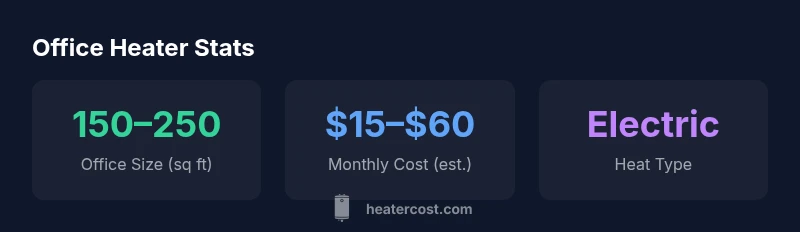
Sizing is the most overlooked step in office heating. Start by calculating the room volume (length x width x height) and outlining the number of occupants and equipment that generate heat. A small 150–250 square foot office typically needs 4,000–6,000 BTU of supplemental heat, while larger spaces may require more. In practice, you should avoid oversizing, which can cause draft cycles and wasted energy, and undersizing, which leaves cold spots. For office heater strategy, map the worst-case cold day and test a conservative wattage. The goal is steady, comfortable temperatures rather than dramatic swings. The office heater should be placed away from drafts, on a stable surface, and with clearance to prevent heat buildup around furniture and electronics. Monitoring room temperature with a thermostat helps maintain consistent comfort for occupants.
Energy sources and heater types for the office
In most offices, electric heat dominates due to safety and ease of installation. Electric space heaters are portable, quick to deploy, and available in fan-forced, ceramic, and oil-filled variants. Infrared panels heat objects rather than air, which can be more efficient in drafty rooms. For ultra-quiet environments, radiant ceiling panels provide gentle heat with near-silent operation. While gas-fired units exist, their use in typical offices is uncommon due to ventilation requirements. When evaluating an office heater, consider efficiency, noise, heat distribution, and the potential for overheating outlets. For open-plan areas, combining a central HVAC strategy with zone-controlled devices can reduce peak loads while preserving comfort near workstations.
Calculating operating costs and ROI for an office heater
Operating costs depend on power draw (watts), hours of use, and the local electricity rate. A typical portable electric heater uses about 1,000–1,500 watts per hour; running 6 hours a day for a 20-workday month can result in noticeable energy bills, especially in poorly insulated offices. To estimate costs, multiply wattage by hours, then by your local rate per kilowatt-hour. For a 1,000-watt heater used 6 hours daily, at $0.15 per kWh, monthly energy cost would be roughly $27–$40 in moderate use. To evaluate ROI, compare total installed costs, maintenance, and expected energy savings over a 1–3 year horizon. Based on Heater Cost research, choosing energy-efficient models and proper sizing yields faster payback and lower long-term costs.
Safety, placement, and user considerations
Always follow manufacturer instructions. Ensure clearances of at least 3 feet from walls and flammable objects; use tip-over protection; do not leave heaters unattended around children or pets; ensure cords do not create trip hazards. For office heaters used near electronics, check for electromagnetic interference and cooling requirements. A dedicated outlet or GFCI circuit can improve safety. Regular inspections and proper storage when not in use extend the life of an office heater and reduce risk of fire.
Maintenance and longevity tips for an office heater
Filter cleaning, dust removal from vents, and periodic checks for cracked housings help keep efficiency high. Use manufacturer-recommended lubricants if applicable and inspect power cords for signs of wear. Build a maintenance schedule that aligns with the quarterly HVAC checks in the office. A well-maintained office heater runs more efficiently, reduces energy costs, and extends its usable life.
Open-plan vs private offices: matching heater strategy
Open-plan offices often benefit from a mix of centralized climate control and individual, low-wattage heaters at workstations. Private offices can be warmed with a compact unit or radiant panel to avoid blasting the entire space. In all cases, ensure energy control is integrated with occupancy schedules to avoid heating unoccupied areas. The goal is even heat distribution without competing devices driving peak loads.
Cost-saving strategies and intelligent control
Invest in programmable thermostats, occupancy sensors, and timer-based outlets to reduce idle heat. Use energy-efficient models with higher COP, lower wattage, and better insulation. For transient occupancy, consider plug-in desk heaters with auto shutoff that respond to room temperature rather than manual adjustment. By combining smart controls with proper sizing, you achieve noticeable savings while maintaining comfort for office occupants.
Budgeting for an office heater upgrade: example scenarios
Scenario A: Small private office (120–180 sq ft) with poor insulation and a single occupant. Choose a compact electric heater and insulation improvements. Expected cost range: $100–$300 upfront; annual operating costs modest. Scenario B: Open-plan space (600–900 sq ft) with a central HVAC system and several desks. Add a few zone heaters or infrared panels to complement existing heating. Expected cost: $600–$1,800 upfront; potential energy savings over 1–3 years. Scenario C: High- traffic workspace (large conference area) with intermittent use. Prioritize radiant ceiling panels or warm-air zones with smart controls. Expected cost: $1,200–$3,000 upfront; variable energy savings. These scenarios illustrate how office heater investments align with space size, occupancy, and insulation. The Heater Cost team suggests modeling each scenario with your local energy rates to estimate exact costs.
Comparison of common office heater options
| Option | Typical Heat Output (BTU) | Estimated Monthly Cost (USD) | Best For |
|---|---|---|---|
| Electric space heater | 4,000–6,000 | 15–60 | Temporary or desk-level warming |
| Infrared panel | 3,000–5,000 | 10–40 | Open-plan, quiet spaces |
| Oil-filled radiator | 2,500–4,500 | 20–50 | Small enclosed spaces |
| Ducted HVAC zone heater | 8,000–15,000 | 40–100 | Whole-office zones |
Got Questions?
What is an office heater and when should I use one?
An office heater is a device used to supplement room heating in a workplace. Use it when temperatures are uncomfortable or energy costs from heating are high, ensuring safe use and proper sizing.
An office heater is a device to warm a workspace. Use it when the room is cold and your main heating is insufficient.
What size heater do I need for my office?
Size depends on room square footage, insulation, and climate. Use BTU estimates and manufacturer guidance to choose; avoid oversizing.
Choose a heater based on your room size and insulation.
Are portable space heaters safe for offices?
Portable heaters can be safe when used with safety features, clearances, and supervision. Avoid leaving them unattended around children or pets.
Yes, with proper safety features and supervision.
Can I use a space heater with my existing HVAC system?
Yes, as a supplement; do not rely on a single unit to heat the entire office. Central systems plus zone heaters can improve efficiency.
Yes, it's common to combine.
What are typical operating costs for an office heater?
Costs vary by heater type, usage, and electricity rates. Use a simple calculation: watts x hours x rate per kWh to estimate monthly costs.
Costs depend on how you use it.
Do I need permits or safety inspections for office heaters?
Most portable heaters do not require permits, but follow local codes for electrical work and ensure appliances are labeled and tested.
Check local rules.
“Choosing the right office heater isn't just about upfront price; it's about balancing space, safety, and long-term energy costs.”
The Essentials
- Size the heater to the space to avoid waste
- Prioritize safety features and proper placement
- Use a mix of centralized and portable options for open offices
- Estimate costs with a simple ROI calculation and review yearly