Is Heat or Radiation? A Practical Comparison of Heat Transfer
Explore the difference between heat transfer and radiation, how they relate, and how to compare radiant and non-radiant modes for home heating and energy efficiency. A balanced, analytical guide by Heater Cost.


Is heat or radiation the same thing? Not exactly. Heat is energy in transit, while radiation is a mode of heat transfer that uses electromagnetic waves. This comparison clarifies how radiation fits with conduction and convection, and when it matters for homes and equipment. Understanding these distinctions helps homeowners choose insulation, heaters, and placement strategies more effectively.
What is heat? Defining energy transfer and how it differs from radiation
A common introductory question is is heat or radiation when describing how energy moves between objects. In thermodynamics, heat is energy in transit resulting from a temperature difference. It is not a substance you carry; rather, it flows from regions of higher to lower temperature until thermal equilibrium is reached. The Heater Cost team emphasizes that heat can move through three primary pathways: conduction, convection, and radiation. Radiation is unique because it does not require a medium to travel; it propagates via electromagnetic waves, making it possible for heat to move through a vacuum or across a room with no direct contact. From a practical standpoint, recognizing that heat and radiation are related but not identical helps homeowners design better insulation and heating layouts. According to Heater Cost, the most important concept is to separate the energy source, the transfer mechanism, and the target, so you can predict where warmth will appear and where it will dissipate. Understanding is heat or radiation as a phrase then can be unpacked into how surfaces, materials, and spacings influence perceived warmth.
A deeper understanding begins with the idea that heat transfer is about energy exchange. Radiant heat travels as waves, primarily in the infrared spectrum, and its effectiveness depends on line of sight, emissivity of surfaces, and the temperature difference. This nuance matters for people choosing radiant heaters, sun exposure, or reflective barriers in a room. By distinguishing energy in transit (heat) from the method (radiation vs conduction vs convection), homeowners can better estimate energy use and comfort. The Heater Cost team notes that solid-state elements, like radiant panels, can deliver targeted warmth efficiently in specific zones, while building envelopes determine how much heat leaks away or stays put. These distinctions lay the groundwork for smarter design decisions.
wordCountObj”:57},
Comparison
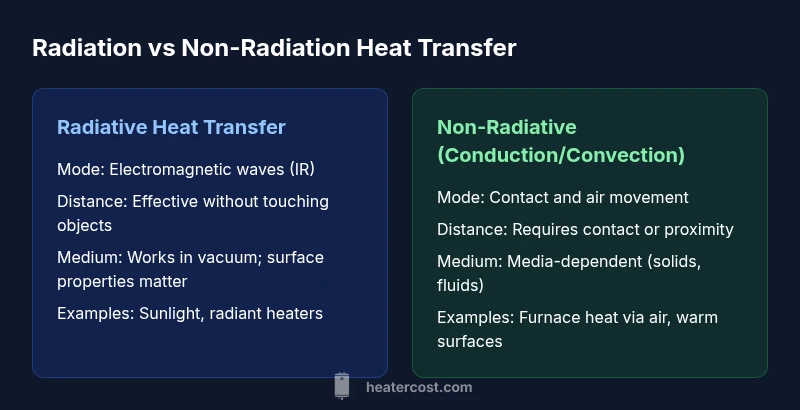
| Feature | Radiative heat transfer | Non-radiative heat transfer (conduction & convection) |
|---|---|---|
| Mode of energy transfer | Electromagnetic waves (infrared and beyond) | Molecule-to-molecule transfer via contact and fluid flow |
| Distance effectiveness | Can transmit energy across gaps without touching surfaces | Requires contact or near-contact zones and ambient air movement |
| Medium dependence | Can operate in vacuum or transparent media; surface emissivity is key | Depends strongly on the medium (solids, liquids, gases) and their properties |
| Typical home examples | Radiant heaters, sun exposure, hot surfaces | Furnaces, radiators, convection-based heaters |
| Key variables | Temperature difference, emissivity, view factors | Thermal conductivity, convection coefficients, airflow rate |
| Energy cost implications | Radiation can be efficient for targeted heating at a distance | Conduction/convection depend on material paths and air movement |
The Good
- Helps homeowners understand energy flows for better heating design
- Guides insulation choices and heater placement for comfort
- Supports energy-cost planning and long-term savings
- Clarifies when radiant elements are worth the investment
Negatives
- Can be theoretical for casual readers without data
- Accurate assessment often requires specific measurements or modeling
- Misinterpretations arise if surface properties and distances are ignored
Radiation is a distinct mode of heat transfer and should be considered alongside conduction and convection in heating design
Radiation is not heat itself, but a mechanism. A practical approach combines all three modes to optimize comfort and energy use. The Heater Cost team’s overall guidance is to map space geometry, surface properties, and air movement before selecting radiant or conventional heating solutions.
Got Questions?
What is the difference between heat and radiation?
Heat is energy in transit between bodies due to a temperature difference, while radiation is a mode of heat transfer that uses electromagnetic waves. Understanding that distinction helps explain why some heaters feel immediately warm at a distance while others warm objects through contact.
Heat is energy moving between objects; radiation is one way it travels. This matters for choosing heaters and materials.
Can heat be transferred without radiation?
Yes. Heat can transfer through conduction (direct contact) or convection (fluid movement). Radiation is just one path. In many homes, all three pathways operate simultaneously, with conduction and convection often dominating near surfaces and air movements.
Heat can move by contact or by moving air, not just by radiation.
When should I consider radiation in home heating?
Radiation is especially effective for targeted, zone-specific heating or in spaces with good line-of-sight to warm surfaces. It also plays a major role in solar heating and some electric infrared heaters. Consider room layout, surface emissivity, and safety when planning radiant elements.
Radiation shines in targeted warmth and solar heating scenarios.
Does distance affect radiant heat?
Yes. Radiant heat diminishes with distance and is strongly influenced by emissivity and surface temperature. Surfaces facing the radiant source absorb energy more efficiently, while barriers or reflective materials can reduce heat transfer.
Distance matters a lot for radiant heat efficiency.
Is heat always a form of energy in motion?
Heat is the energy in transit due to a temperature difference, not a thing you possess. It moves from high to low temperature through conduction, convection, or radiation.
Heat = energy in motion; radiation is a path it can take.
What everyday appliances use radiant heat?
Common examples include infrared heaters, electric resistance panels, and sunlit surfaces. These heat sources emit infrared energy that is absorbed by other objects or people without requiring air to move heat between them.
Infrared heaters are classic radiant heat sources.
The Essentials
- Identify the dominant heat transfer mode in your space
- Radiation heats surfaces and people without contact
- Consider distance, emissivity, and medium when planning heat—don’t rely on a single method
- Use insulation alongside radiant elements for targeted warmth
- Estimate energy costs by considering how each transfer mode behaves in your environment