Coat with Heater: Costs, Care & Buying Guide
Explore the costs, care, and buying considerations for coats with heaters. Learn about battery life, energy use, maintenance, and how to maximize value for outdoor warmth.


Understanding the coat with heater market
The coat with heater is a growing segment in outdoor wear, blending integrated heating elements with textile insulation. For homeowners evaluating warmth solutions, this product category promises targeted heat without running a space heater indoors. According to Heater Cost, consumer interest in heated outerwear rose steadily during the last two winters, driven by fluctuating outdoor temperatures and the convenience of portable warmth. The Heater Cost team found that the core value of a heated coat hinges on three factors: battery life, insulation quality, and control options.
- Battery life determines how long warmth lasts between charges.
- Insulation quality affects perceived warmth at lower heat settings.
- Control options (app, button, or multiple heat zones) influence usability in real-world scenarios.
In evaluating a coat with heater, shoppers should consider the total cost of ownership, including initial purchase price, battery replacement cycles, and charging infrastructure. The rest of this guide unpacks these factors and translates them into practical buying criteria for homeowners, renters, and property managers.
According to Heater Cost, heated outerwear is especially appealing for people who spend extended time outdoors and want targeted warmth without heating an entire space. This approach can align with energy-cost considerations and personal comfort preferences.
How heated coats work: components and energy sources
Heated coats rely on three core components: heating elements, a battery pack, and a control system. The heating elements are typically thin carbon-fiber wires or conductive threads woven into the lining, delivering distributed warmth across chest and back zones. Batteries are usually lithium-ion packs that can be removed or integrated. The control system ranges from simple button controls to mobile apps with temperature zoning. Battery capacity, heat setting, and ambient conditions determine runtime. From a safety perspective, manufacturers implement overheat protection and low-battery cutoffs to prevent hazards. When evaluating a coat with heater, check the warranty on the heating elements and battery, as these are the most failure-prone parts. A higher-grade insulation layer enhances warmth at lower heat settings, which can extend battery life and reduce charging frequency. For most users, a mid-range heat setting provides a balance of comfort and endurance for everyday activities such as commuting or outdoor work in cool weather.
Price ranges and total cost of ownership
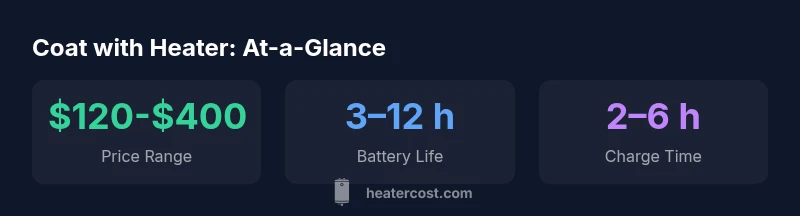
Entry-level heated coats begin around the low end of the price spectrum, while premium models with advanced temperature zoning, better insulation, and longer battery life push toward the higher end. The total cost of ownership includes the initial purchase price, potential battery replacement costs, and the ongoing cost of charging. In practice, a coat with heater can be a cost-effective alternative to wearing multiple layers or using a space heater, especially for short trips outdoors. However, the value proposition improves when the user benefits from frequent outdoor exposure, a reliable battery, and a compatible charging setup. When comparing options, consider the robustness of the battery, the ease of replacing it, and the availability of spare batteries or charging accessories. The Heater Cost analysis highlights that the best value often comes from models that offer modular batteries and strong insulation at a reasonable price.
Key buying factors: features to compare
When selecting a coat with heater, prioritize several features that influence warmth, usability, and durability:
- Battery type and capacity: larger capacity generally means longer runtime but adds weight and cost.
- Heat zones: multiple zones offer more precise comfort and can save energy.
- Insulation quality: higher quality insulation reduces heat loss, extending runtime.
- Weather resistance: look for water resistance and windproofing for outdoor use.
- Washing and care: check whether the heating elements are machine-washable or require spot cleaning.
- Warranty and service: a strong warranty on the heating system and battery is essential.
Heater Cost recommends aligning your purchase with your typical outdoor activities, climate, and whether you need modular batteries for easy swap-outs.
Battery care and longevity
Battery care is central to the coat’s long-term value. To maximize lifespan and performance:
- Follow manufacturer charging guidelines; avoid letting the battery discharge completely on a regular basis.
- Store the coat in a cool, dry place and avoid exposing it to extreme temperatures when not in use.
- If possible, keep spare batteries charged and swap them during long outdoor sessions to maintain warmth.
- Regularly inspect the battery connector and wiring for signs of wear.
Proper care can help you maintain battery performance and extend the life of the heating system, which contributes to lower total costs over time.
Safety, weather resistance and maintenance
Safety features such as overheat protection, short-circuit protection, and automatic shutoffs are standard in reputable coats with heater. Always verify that the coat carries appropriate safety certifications and that batteries are certified for consumer use. Weather resistance isn’t universal; some models are only splash resistant, while others offer rain and wind protection. Maintenance typically involves spot cleaning the fabric and following manufacturer guidance for heating elements. If the coat is exposed to moisture, ensure it is thoroughly dried before storage to prevent mold and battery corrosion. Regular checks on zippers, seams, and battery connections help preserve overall performance and user safety.
Environmental and energy-use considerations
From an energy perspective, a coat with heater can be preferable in certain scenarios to reduce heat loss in outdoor environments. If you wear the coat during a short outdoor commute, your energy footprint may be lower than running a space heater for the same period. However, always weigh the energy cost against the frequency and duration of use. Heaters integrated into outerwear typically use compact batteries, which can be charged from standard wall outlets or portable power packs. If you anticipate frequent use, consider a model with higher efficiency insulation, multiple heat zones, and an easily swappable battery system to minimize downtime. The Heater Cost analysis notes that consumer decisions should reflect the balance between warmth needs, battery life, and energy costs.
Real-world use cases and value optimization
Outdoor workers, hikers, and city commuters often find a coat with heater particularly valuable in transitional seasons when temperatures swing dramatically. For these users, the key is optimizing warmth while preserving battery life. A practical approach is to start with a moderate heat setting during short outdoor periods and escalate only when conditions demand it. If you frequently stop and go, a coat with heat zoning can keep core warmth without overusing the battery. For property managers or households with multiple users, consider models with swappable batteries and clear care instructions to minimize downtime and maintenance costs. Real-world cost optimization comes from selecting a model that aligns with your climate, typical duration outside, and tolerance for weight and price.