Battery Backups for Heaters: Power Options and Costs
Explore battery back-ups for heaters, including storage options, costs, safety, and practical sizing tips for homeowners, renters, and property managers.


A battery can back up home heating, but its scope depends on the type of heater and storage capacity. Most space heaters run on standard mains power, while backup options like home energy storage, generators, and UPS systems support controls or select units during outages. Expect typical runtimes to range from a few hours to half a day with careful sizing.
What the phrase battery for heater covers in residential heating
When homeowners talk about a battery for heater, they usually mean one of two things: a battery-backed energy storage system that can power heating controls or, in some cases, a system that provides limited power to a portable heater during an outage. In most homes, electric space heaters require mains power to operate at full capacity, so a battery dedicated to running an entire heater is uncommon. For backup power, people typically rely on a combination of energy storage, generators, and uninterruptible power supplies (UPS) to keep essential controls and thermostat functions alive. If you’re evaluating options, focus on what exactly you want powered during an outage: thermostats, smart thermostats, zone valves, or the heater itself in a limited way. The keyword battery for heater often triggers questions about safety, installation, and cost, all of which Heater Cost analyzes to help homeowners avoid over-investing in unneeded capacity while still maintaining warmth during outages.
Backup power options that can support heating
There are several viable approaches to backing up heating loads, each with trade-offs in cost, reliability, and heat delivered. The most common are: (1) Home energy storage systems coupled with solar or the grid, which store electricity for later use; (2) Portable or whole-home generators that provide temporary power during outages; (3) Uninterruptible Power Supplies (UPS) focused on critical controls and smart thermostats; and (4) Fuel-cell or hybrid systems that convert fuel to electricity for backup loads. For most homes, a combination of these options offers the best balance between reliability and cost. When sizing, think about what portion of your heating load you want to protect, how long outages last in your area, and whether you want to power just a thermostat or a larger portion of the heating system.
How to size a backup battery for a heater
Sizing begins with identifying the exact heater load and the desired outage duration. Start by finding the heater’s wattage (or BTU equivalence) and the number of hours you want to cover. Convert watts to kilowatt-hours (kWh) using the formula: kWh = (watts × hours) / 1000, then factor in inverter efficiency (roughly 85–95%). Add a margin for aging and peak demand. For example, powering a 1500W heater for 4 hours would require roughly 6 kWh of usable energy before accounting for inverter losses. If you plan to run just a smart thermostat and a control module, a smaller storage unit may suffice. Always design with a safety buffer and consider future heat-load changes (e.g., draftier spaces or larger rooms).
Cost considerations and ROI for backup heating power
Costs vary widely by system size, installation complexity, and whether solar is part of the package. Small battery backups for controls can start in the low thousands, while full home storage paired with solar can rise into the several-thousand-dollar range. Ongoing costs include maintenance, battery replacement every 5–15 years, and potential inverter upgrades. From a return-on-investment perspective, consider outage frequency, the value of uninterrupted warmth, electricity rate trends, and the costs your area imposes for outages or heat loss. Heater Cost analyses in 2026 show that the total cost of ownership improves with higher-usage patterns and longer outages, but every home must weigh upfront expense against expected benefits.
Safety and installation considerations for battery-backed heating
Safety is non-negotiable when introducing backup power for heating. Ensure proper ventilation where combustion-based heaters are present, and install carbon monoxide detectors near sleeping areas and heaters. Have all work performed or inspected by a licensed electrician or HVAC professional to meet local codes and manufacturer requirements. Use equipment with recognized safety certifications and observe battery storage guidelines, including thermal management and fire protection. In multi-family buildings or rentals, coordinate with property management to align with building codes and insurance requirements.
Practical recommendations and best practices for homeowners
- Determine essential heat: identify which spaces require continuous warmth during outages and tailor backup sizing to those areas.
- Prioritize safety: install CO detectors, smoke alarms, and maintain clear access to all heaters and backup equipment.
- Plan for expansion: select a modular storage system that can scale up when you upgrade heaters or add insulation.
- Optimize energy use: seal drafts, upgrade insulation, and use programmable thermostats to reduce runtime while preserving comfort.
- Get professional input: an HVAC specialist can translate your heat-load data into a precise backup plan that aligns with your budget.
For renters and property managers: practical planning for battery-backed heating
Renters and property managers should emphasize non-invasive, portable solutions that don’t require permanent electrical work. For apartments or rental houses, look for compact UPS units for critical controls and smart thermostats, paired with a small battery backup that can bridge short outages. Property-wide storage with a solar array can be a long-term investment, but ensure lease terms allow modifications and that insurance coverage is adequate. When budgeting, factor in energy resilience as a value-add amenity for tenants.
Structured comparison of backup options for heating power
| Option | Typical Runtime (hours) | Key Power/Capacity | Pros/Cons |
|---|---|---|---|
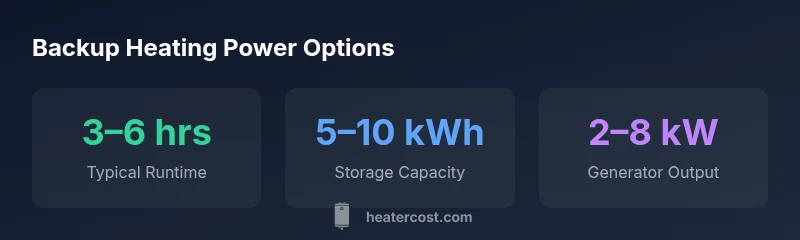
| Home energy storage (solar+storage) | 3–6 hours | 5–10 kWh usable | Pros: quiet and scalable; Cons: high upfront cost |
| Portable UPS for controls | 0.5–8 hours | 0.25–1 kWh | Pros: inexpensive; Cons: only powers controls, not heater |
| Backup generator | 3–12 hours | Output depends on fuel (2–8 kW) | Pros: reliable in outages; Cons: fuel and emissions |
| Mains-powered with thermostat backup | N/A | N/A | Pros: simple; Cons: relies on grid during outage |
Got Questions?
What is the simplest way to back up heating during a power outage?
The simplest approach is to identify critical loads (thermostats and smart controls) and pair a small UPS with a backup heat source for limited space. For broader coverage, consider a modest home storage system or a portable generator to run a larger portion of the system during outages. Always plan for essential warmth first and safety considerations.
Identify essential loads like thermostats and controls, then pair a UPS with a backup generator or storage system to cover critical heating during outages.
Can I power my space heater with a battery pack?
Most electric space heaters require mains power to deliver full heat. Some compact heaters can run on a battery pack for low output or for pilot safety devices, but heat output will be limited. For meaningful warmth, energy storage paired with smart control is usually more effective.
Most space heaters need mains power, and battery packs only provide limited heat output. For real warmth, combine storage with a control system.
How long does a home energy storage system last for heating?
Runtime depends on the storage capacity and the heater's load. With a typical home storage unit, you can expect several hours of reduced heating or delayed heat loss, but full-room heating during long outages generally requires a larger system and careful load management.
Runtime varies by capacity and load; expect several hours for smaller setups and longer outages with larger storage.
Are there safety concerns combining heating devices with backup power?
Yes. Ensure proper ventilation for combustion-based heaters, keep detectors like CO alarms functional, and use professionally installed equipment. Do not bypass safety features, and follow manufacturer guidelines for all backup components.
Safety matters: ventilate when using combustion heaters, maintain CO detectors, and have professionals install backup gear.
What is the typical upfront cost range for backup battery systems?
Upfront costs vary by capacity and configuration. Small, control-focused backups can start in the thousands, while whole-home storage with solar additions can run higher. Factor in installation, permits, and potential battery replacement every several years.
Costs range from a few thousand for controls to several thousand for full-home storage; plan for installation and maintenance.
“Backup power strategies for heating should prioritize safety, reliability, and total cost of ownership; a properly sized system can keep essential warmth during outages without overwhelming operating budgets.”
The Essentials
- Define your heat needs before choosing a backup.
- Battery storage is most effective when paired with solar.
- Costs vary widely; plan for upfront and maintenance.
- Safety and code compliance are critical.
- Renters and managers should prioritize reliable, low-noise solutions.