Which Is Better Room Heater: Infrared vs Convection Compared
Explore which room heater type is better for your space, comparing infrared/panel vs convection heaters, with safety, efficiency, costs, and real-world use cases to guide your choice.


For which is better room heater, the answer depends on your space and heating goals. Infrared/panel heaters deliver fast, targeted warmth and are ideal for small rooms, while convection heaters warm the air for even heat in larger spaces. Consider room size, insulation, and safety features to choose the best option for your home.
Understanding the Which Is Better Room Heater Question
When homeowners ask which is better room heater, the answer isn't a single brand or model. The core question is about selecting the heating approach that best suits your space, usage patterns, and comfort goals. Room heating technologies fall mainly into radiant (infrared/panel) and air-based (convection) systems. Radiant heaters emit warmth that you feel on skin and objects, while convection units raise the room temperature by warming the surrounding air. In practical terms, the choice hinges on how you plan to use the heater: quick warmth for a person seated near the unit, or steady, even heat for a larger living area. According to Heater Cost, a thoughtful comparison should weigh delivery speed, heat distribution, insulation, and safety features. The goal is not to chase the lowest upfront price, but to maximize comfort while keeping long-term costs predictable. In the end, which is better room heater depends on the specific room, its insulation, and how you live in that space. The Heater Cost Team emphasizes context over trend, guiding homeowners to a tailored solution.
Heat Delivery Methods: Infrared vs Convection
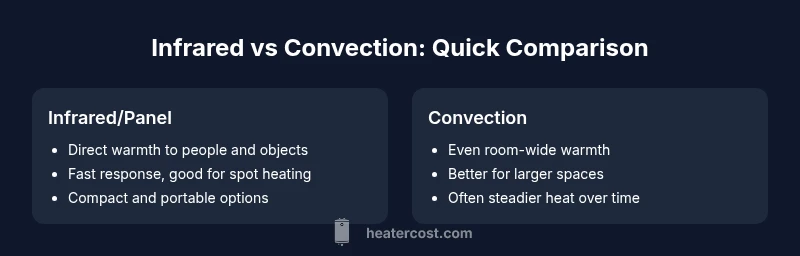
Radiant infrared heaters, often sold as panel or puck-style units, warm people and objects in their line of sight. They feel warm immediately when you stand near the heater, and heat can persist even if the room temperature isn’t high yet. Convection heaters warm the air, creating a circulating current that blankets the room in warmth over time. In practice, infrared is excellent for spot heating in small rooms, bathrooms, or near a desk, while convection shines in living rooms and open-plan spaces where even, whole-room warmth matters. Some modern heaters blend both approaches, using radiative elements for quick comfort and a fan-assisted or natural-convection mode to spread heat. Evaluating heat delivery alongside insulation helps pinpoint which type aligns with your daily routines and comfort expectations. For homeowners, this distinction is a starting point to compare models and avoid overpaying for capabilities you won’t use.
Room Size, Insulation, and Placement
The size of the space you want to heat is a primary driver in choosing a heater. A small, well-insulated room may feel comfortably warm with a compact infrared panel, whereas a larger living area with drafty corners benefits from a unit that circulates warm air effectively. Insulation quality, window exposure, and ceiling height all influence how quickly a space loses heat and how many watts are needed to maintain comfort. Placement matters too: avoid obstructing vents or heat pathways, position heaters away from curtains or furniture, and prioritize outlets at safe distances from moisture or flammable materials. Good placement reduces heat loss and lets the device perform closer to its rated efficiency. In practice, you’ll often see homeowners experiment with a primary heater and a portable supplementary unit to address specific hot spots in the room.
Energy Costs and Efficiency: What to Look For
Energy efficiency for room heaters is guided by heat delivery method, wattage, thermostat control, and user behavior. Look for models with precise thermostats, low-watt or variable-speed elements, and automatic shutoff after reaching a target temperature. Energy cost considerations hinge on how long you run the device and how well the space holds heat. The Heater Cost Analysis, 2026, highlights that insulation quality and usage patterns have a larger impact on operating costs than a device’s rated efficiency alone. When comparing infrared versus convection, consider not just the device’s efficiency rating but how well it reduces waste heat and limits unnecessary running time. A model with seasonal energy-saving modes and clear energy labels can help you keep running costs predictable without compromising comfort.
Safety Features, Maintenance, and Longevity
Safety should be central to any space heater decision. Look for overheat protection, tip-over switches, and cool-touch exteriors, especially in homes with children or pets. Maintenance tends to be straightforward: keep filters clean where applicable, wipe down dust from grills, and inspect cords for wear. Infrared panels require careful handling to avoid damage to the heating surface, while convection units rely on unobstructed air paths. Longevity is linked to build quality, proper clearance around the unit, and adherence to manufacturer guidelines for usage and storage. Investing in a model with a solid warranty and readily available replacement parts helps preserve value over time. From a practical perspective, frequent moves and seasonal use should factor into your expected lifespan and maintenance routine.
Upfront Costs, Warranties, and Value Over Time
Upfront costs for room heaters vary with size, heat delivery method, and features. Infrared panel heaters tend to be compact and affordable, while larger convection units may carry higher upfront prices due to larger heat output and more robust control systems. Warranties vary by brand and model, but most reputable heaters offer at least a one-year warranty, with longer coverage for core components in higher-end products. Value over time considers not only purchase price but energy savings, heat retention, and reliability. A well-chosen heater that perfectly matches room size and usage can reduce the need for supplemental heating and lower overall energy bills, offsetting higher initial costs. In the end, the best choice balances upfront affordability with long-term comfort and predictable operating costs.
Noise, Aesthetics, and Placement in Real Homes
For many, noise level and visual fit matter nearly as much as performance. Infrared panels are typically silent, which is ideal for bedrooms or study spaces, while some convection units use fans that generate perceptible hums. Aesthetics matters for visible placement; sleek panels can blend with décor, while bulky units may dominate a room. Placement considerations include safety clearances, accessibility to an outlet, and the ability to heat the intended zone without creating drafts across the room. Homeowners often favor low-profile designs that can be tucked under desks or mounted on walls, provided they meet clearance and mounting guidelines. By prioritizing both form and function, you can select a heater that complements your space while delivering reliable warmth.
Practical Buying Scenarios: Bedroom, Living Room, Home Office
In a bedroom, prioritize quiet operation and stable, gentle warmth—infrared panels near the bed can deliver comfort without the risk of overheated air. For living rooms, an evenly heated environment benefits from convection-based models with good air distribution and a thermostat that helps maintain a calm ambient temperature. A home office benefits from a portable heater that can be directed toward the workspace for targeted comfort, while keeping the rest of the room at a comfortable baseline temperature. Across scenarios, a multi-zone strategy using one primary heater and one portable unit often yields the most consistent comfort while avoiding over-heating any single area. The key is to match the heat delivery style to the typical occupancy pattern and the room’s thermal profile.
How to Read Labels and Specs Like a Pro
Labels and spec sheets can be dense, but they reveal practical clues about performance. Start with the heat output rating (wattage) and the type of heat delivery. Check the thermostat range and whether the unit offers an automatic shutoff, child safety controls, and tip-over protection. Reviews and efficiency ratings can corroborate the manufacturer's claims, and warranty terms reveal the level of post-purchase support. If a model boasts rapid heat response, verify how quickly it reaches its target temperature and whether that performance sustains over several hours. Reading the manual for proper use, clearance requirements, and safety cautions will help you avoid misuse and extend the heater’s life.
Quick Setup Tips to Maximize Comfort and Efficiency
A few practical steps can optimize comfort and keep operating costs predictable. Start with sealing obvious drafts around doors and windows to minimize heat loss. Place the heater in a central location for even coverage, or position a portable unit to address a specific cold spot. Use a programmable thermostat or a timer to align heat with occupancy patterns, reducing unnecessary runtime. Regularly check for dust buildup and ensure cords are out of walkways to prevent accidents. Finally, pair a reliable insulation strategy with a heater that matches room size to avoid overworking any single device.
Trade-Offs and a Decision Framework
Choosing between infrared and convection heaters involves weighing immediacy against uniform warmth, portability against coverage, and upfront cost against long-term operating costs. If you frequently heat a small, occupied space with a focus on quick warmth, infrared can be efficient and satisfying. If your goal is steady warmth across a larger room or open area, convection-based heaters may provide superior comfort without constant adjustment. The decision framework is simple: assess room size and insulation, define occupancy patterns, compare heat delivery and warranty terms, and then select the heater that best aligns with your home’s thermal profile. Heater Cost recommends prioritizing heat delivery that matches real living patterns over theoretical efficiency alone.
Final Decision Framework: When to Choose Which Type
In summary, for spot heating, fast warmth, and portability, infrared/panel heaters are often the better option. For full-room comfort, even warmth, and longer sessions across larger spaces, convection heaters tend to win. Consider a hybrid approach if you regularly oscillate between small, occupied zones and larger gathering areas. The optimal choice also depends on your insulation, local climate, and how you use heat in daily life. By grounding the decision in room characteristics and usage, you can select the best room heater with confidence.
Comparison
| Feature | Infrared/Panel Heaters | Convection Heaters |
|---|---|---|
| Heat delivery | Radiant warmth targeted to people/objects | Warm air circulated for whole-room comfort |
| Best for | Spot heating in small spaces or near occupants | Even heating in larger rooms and open areas |
| Response time | Very fast warmth when aimed at the user | Slower to heat up whole room but steady once warm |
| Typical upfront cost | Low to moderate for compact panels | Moderate to high for larger units with controls |
| Maintenance | Minimal maintenance; clean panels periodically | Moderate maintenance; clean grilles and check cords |
| Best energy fit | Small, occupied spaces; energy use aligns with quick, short sessions | Larger rooms; energy use aligns with longer, even warmth |
The Good
- Immediate warmth in the target area
- Compact, portable options available
- Simple operation and maintenance
- Quiet operation in many models
Negatives
- Heat may feel uneven in larger spaces
- Direct radiant warmth can cause hot spots near the device
- Airflow in convection units can create drafts if poorly placed
- Operating costs depend heavily on room insulation and usage
Infrared heaters excel for targeted warmth; convection heaters excel for even, room-wide warmth
Choose infrared when you need fast, localized heat for small spaces. Choose convection when you want consistent warmth throughout a larger area with fewer temperature swings.
Got Questions?
What is the main difference between infrared and convection room heaters?
Infrared heaters deliver radiant heat to objects and people, creating quick warmth in targeted areas. Convection heaters warm the air to circulate warmth throughout the space, offering more uniform comfort. Your choice should depend on room size, occupancy patterns, and insulation.
Infrared heats you directly, convection heats the air in the room. Pick based on room size and how you use the space.
Which heater is more energy-efficient for a bedroom?
In a bedroom, a quiet infrared panel can provide comfortable warmth with limited energy use when you’re nearby. A convection heater with a programmable thermostat can maintain a steady temperature overnight with controlled cycling. Efficiency depends on insulation and usage patterns.
Infrared is efficient for direct warmth in bedrooms; convection works well with a thermostat for steady overnight comfort.
Are space heaters safe to use around children and pets?
Modern space heaters include safety features like tip-over switches and overheat protection. Always place units on level surfaces away from activities, keep cords out of reach, and never leave them running unattended with young children or pets.
Choose models with tip-over and overheat protection, and keep them out of reach of kids and pets.
Can I use a room heater as a primary heat source?
Most homes rely on space heaters as a supplement rather than a primary source, especially in chilly climates. For reliable whole-room comfort, a combined approach with a central or radiant system plus a supplementary heater is common.
Usually not as the only heat source; use as a supplement alongside a primary system.
How do I compare energy costs between heater types?
Focus on usage patterns, insulation, and heat delivery efficiency. Read energy guides on labels, compare thermostat features, and estimate runtime hours. Actual costs depend on how long you heat each day and how well the space retains warmth.
Look at usage habits and insulation, not just the model’s label.
The Essentials
- Assess room size and insulation before choice
- Infrared is ideal for spot heating and quick warmth
- Convection provides even heat for larger spaces
- Match thermostat controls to usage to save energy
- Check warranties and safety features for longevity