Quartz Heater vs Ceramic: A Practical Comparison for Home Heating
Compare quartz and ceramic space heaters to understand heat delivery, efficiency, safety, and best-use scenarios. Practical guidance from Heater Cost helps homeowners decide.


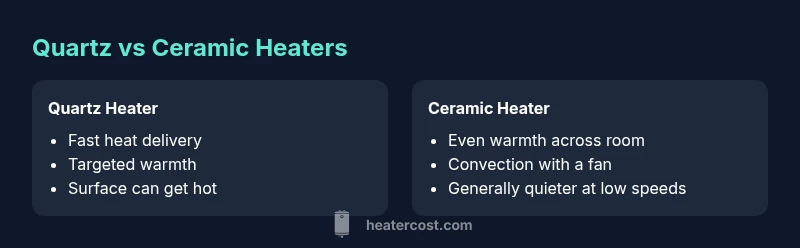
When choosing between a quartz heater and a ceramic heater, consider heat delivery and room coverage: quartz heaters warm you quickly with focused radiant heat, while ceramic heaters provide steadier, more uniform warmth with broader coverage. For fast spot heating in small areas, quartz is often preferred; for long sessions and larger spaces, ceramic typically offers more consistent comfort. Both types come in portable and built-in forms, so assess your space, safety needs, and energy use to decide which fits best.
What Are Quartz Heaters and Ceramic Heaters?
Quartz heaters and ceramic heaters are popular electric space heaters, but they use different technologies to generate warmth. A quartz heater relies on quartz tubes or elements that emit radiant heat directly to objects and people in its line of sight. A ceramic heater uses ceramic plates that warm up and then radiate heat, often aided by a fan to push warm air into the room. The quartz option typically excels at delivering fast, targeted warmth to a specific area, while ceramic units are designed to spread warmth more evenly, covering a larger portion of the room over time. Understanding these distinctions helps homeowners match a heater to their heating goals, room layout, and safety preferences. According to Heater Cost, the decision often comes down to whether you want rapid heat on a person or uniform heat across a space, and how much space you need to cover.
Heat Delivery: Radiant vs Convection
Radiant heat from a quartz heater travels directly through space and can feel instantly warm when you sit in front of it. This makes quartz heaters ideal for spot heating near a desk, in a bathroom, or by a reading chair. Ceramic heaters, on the other hand, typically combine radiant warmth with convection. The ceramic core heats up and transfers heat to the surrounding air, which is then circulated by a built-in fan. This convection component helps distribute warmth more evenly, reducing cold spots in a room. For homes with efficient insulation, a quartz heater can be a powerful short-term solution, while a ceramic heater may be more comfortable for longer sessions in larger rooms. The Heater Cost team notes that the best choice depends on how you plan to use the heater and the room’s layout.
Efficiency and Heat-Up Time
Efficiency in space heating is highly model-dependent, but the technology generally dictates performance patterns. Quartz heaters tend to deliver heat quickly and are effective for rapid warmth at close range. Ceramic heaters typically reach a steady state faster than older, pure radiant heaters but may take a moment longer to maximize warmth across an entire room. Because heat distribution is tied to fan operation and airflow, ceramic models can feel less intense in a small, enclosed space but deliver more even comfort in larger areas. In practice, homeowners should weigh how quickly they need warmth against how consistently they want that warmth to persist as the room’s temperature stabilizes.
Safety Features and Practical Considerations
Both quartz and ceramic heaters include common safety features such as tip-over switches, overheat protection, and cool-to-touch housings to minimize burn risk. Quartz heaters often have a smaller heat footprint and can become very hot at the surface, so placement away from pets and children is important. Ceramic heaters with fans can distribute heat more evenly but may feel noisier depending on the model and fan speed. For households with shared spaces or children, a ceramic model with multiple safety modes and a low surface temperature setting can reduce risk while maintaining comfort. The Heater Cost analysis emphasizes choosing models with a programmable thermostat and a shut-off timer to optimize both safety and energy use.
Use-Case Scenarios: When to Choose Quartz
If you frequently need quick warmth in a tight spot—such as a home office, workshop corner, or a bathroom—a quartz heater is often the better choice. Its radiant heat acts directly on occupants and objects, delivering near-immediate comfort without warming up the entire room. This can be especially useful on cold mornings or during brief usage windows. Quartz models are typically more compact and portable, making them a strong option for renters or households that rotate heat sources between rooms. When storage and ease of relocation matter, a quartz heater earns strong consideration.
Use-Case Scenarios: When to Choose Ceramic
Ceramic heaters shine when you want broader room coverage and a steadier temperature over longer periods. In living rooms, bedrooms, or open-plan spaces, ceramic units with convection help create uniform warmth that reduces cold spots and temperature swings. If you frequently endure longer sessions or have a larger seating area, ceramic heaters provide more consistent comfort without the need to readjust heat settings as often. They’re also more forgiving in terms of perceived warmth at intermediate distances, which many households find preferable for all-day use.
Practical Buying Considerations: Features That Make a Difference
When comparing models, focus on practical features that affect daily use: programmable thermostats, multiple heat settings, oscillation or directional heat, safety certifications, and energy-saving modes. Look for user-friendly controls, clear indicators, and robust build quality. Decide whether you prefer a compact heater for a desk or a larger unit designed to heat a living space. Consider noise level, especially if the heater will sit in a bedroom or study. Finally, evaluate the total cost of ownership, including electricity use, maintenance needs, and potential warranty terms. As Heater Cost notes, the right model aligns with your room size, usage patterns, and safety priorities.
Common Misconceptions About Quartz and Ceramic Heaters
Many people assume quartz heaters are dangerous due to their high surface temperatures, but with proper placement and child- or pet-proofing, they can be safe when used as directed. Others think ceramic heaters always run quietly; while many do, some models with high fan speeds can be audible in quiet spaces. In reality, the best choice depends on your space, usage, and tolerance for mechanical noise. The key is to pick a model with reliable safety features and proven performance that matches your needs.
How to Compare Models: A Step-by-Step Checklist
- Define your room size and how you’ll use the heater (spot warmth vs. whole-room comfort).
- Check heat delivery type (radiant vs. convection) and how quickly each model warms the space.
- Review safety features: tip-over switch, overheat protection, and child/pet safety measures.
- Compare energy-saving settings and thermostat accuracy for stable comfort.
- Inspect build quality, warranty, and noise level when the fan is active.
- Consider portability, cord length, and storage considerations for renters or flexible spaces.
- Read independent reviews and verify that the model has passed recognized safety certifications.
- Estimate long-term operating costs based on typical usage patterns and room insulation.
Installation, Safety, and Maintenance Tips
Electrical safety starts with choosing the right outlet and avoiding daisy-chaining heaters with other devices. Place heaters on level, non-combustible surfaces and maintain at least a few inches of clearance around all sides. Regularly inspect cords for wear, and keep the heater clean from dust to preserve efficiency. For units with fans, ensure air intake and exhaust are unobstructed. Store units when not in use to extend their life, and follow manufacturer maintenance recommendations. Heater Cost emphasizes keeping safety front and center, especially in homes with children or pets.
Final Thoughts: Choosing with Confidence
In the quartz heater vs ceramic debate, there is no one-size-fits-all answer. Your space, usage patterns, and safety priorities should guide the decision. If you need rapid warmth for a small area, quartz excels; if you want steady, even heat across a larger room, ceramic typically delivers better comfort over time. By evaluating heat delivery, efficiency, safety, and operating costs, you can select a model that aligns with your home heating goals and budget. Heater Cost’s guidance is to choose the option that best suits your circumstances while ensuring reliable performance and safety.
Comparison
| Feature | quartz heater | ceramic heater |
|---|---|---|
| Heat delivery | fast radiant warmth to targeted areas | broader, more even warmth with convection |
| Warm-up time | near-immediate warmth in line of sight | slightly longer to reach even room temperature |
| Noise | usually quiet during operation, varies by model | often has a fan; noise depends on speed setting |
| Safety features | tip-over switch, overheating protection common | tip-over switch, overheating protection, fan safety considerations |
| Best for | spot heating, small spaces, quick tasks | whole-room comfort, larger spaces |
The Good
- Quartz heaters offer rapid, targeted warmth for quick relief in small areas
- Ceramic heaters provide steady, even heat across larger spaces
- Both types are generally compact and portable for flexible use
- Modern models include safety features and energy-saving options
Negatives
- Quartz heat can be intense at the surface and may feel uneven in larger rooms
- Ceramic heaters with fans may be noisier and consume more electricity in some models
Ceramic for room-wide comfort; quartz for fast, focused warmth
Choose quartz when you need quick heat in a small spot. Choose ceramic when you want even warmth across a larger area and longer comfort.
Got Questions?
Are quartz heaters safer than ceramic heaters?
Both types can be safe when used correctly and equipped with typical safeguards like tip-over switches and overheat protection. Quartz heaters usually have a hotter surface, so placement away from children and pets is important. Ceramic heaters with built-in fans can distribute heat more evenly, but you should still follow clear safety guidelines.
Both quartz and ceramic heaters are safe when used properly—keep them away from kids and pets, and use the built-in safety features.
Which heats up faster, quartz or ceramic?
Quartz heaters generally heat up faster due to radiant heat that warms objects directly. Ceramic models take a bit more time to reach peak comfort because heat is distributed through convection, warming the air first.
Quartz heats up quicker; ceramic takes a moment longer to warm the room evenly.
Can I use these in a bedroom safely?
Yes, both can be used in bedrooms, but choose models with quiet operation, stable thermostats, and a cool exterior. Place heaters away from bedding and curtains, and ensure proper ventilation and cord management.
You can, as long as you pick a quiet model and keep it away from anything flammable.
Are there energy-saving models available for quartz or ceramic heaters?
Many models offer programmable thermostats, timers, and eco modes designed to reduce energy consumption. These features help you balance comfort with operating costs while maintaining safe temperatures.
Look for smart thermostats and eco modes to cut energy use without sacrificing comfort.
How do I decide between quartz and ceramic for a small apartment?
For a small apartment, a quartz heater can provide fast warmth in a targeted area without overheating the entire space. If you want more even, longer-lasting warmth throughout the room, a compact ceramic heater might be a better fit.
If you need fast spot heat, pick quartz; for even warmth across the room, go ceramic.
What maintenance do these heaters require?
Regularly dust and clean heater grilles, inspect cords for wear, and follow manufacturer guidelines for routine checks. Most issues can be avoided with periodic cleaning and proper storage when not in use.
Keep them clean, check cords, and store properly when not in use.
The Essentials
- Assess whether you need spot warmth or whole-room comfort
- Prioritize safety features and energy-saving options
- Consider room size, layout, and insulation before buying
- Check noise level if the heater will reside in a bedroom or office
- Compare warranties and maintenance needs to maximize value