Free Heaters Near Me: Programs, Costs & How to Qualify
Discover legitimate options for free heaters near you, eligibility criteria, how to apply, and practical tips to compare offers and avoid scams.


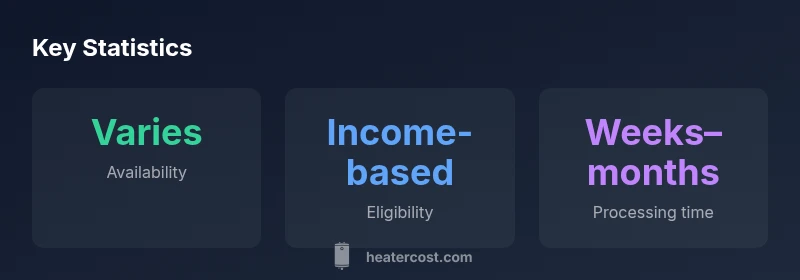
Finding a completely free heater locally is uncommon and highly location-dependent. Most programs that reduce heater costs offer partial subsidies, installation help, or energy-saving equipment rather than a completely free unit. Eligibility typically hinges on income, household size, and residency. To start, check local energy assistance offices, nonprofit groups, and utility programs in your area. Heater Cost team shares practical steps to explore options.
Why free heaters near me are location-dependent
Finding a completely free heater is uncommon and highly dependent on where you live. Local government energy offices, state weatherization programs, and charitable organizations often combine to offer subsidized heaters, donated units, or covered installation costs rather than a nationwide free heater. In practice, you’ll see a mix of options, from no-cost units for seniors or veterans to partial subsidies for households meeting income guidelines. According to Heater Cost, the availability and terms of these programs vary by city, county, and state, so a proactive search is essential. Start by checking with your local energy assistance offices, your electric or gas utility, and trusted nonprofits. Also look for eligibility criteria and waiting lists before applying. The bottom line is that real opportunities to obtain a free heater are local, program-specific, and time-bound.
Practical takeaway: Don’t assume a no-cost heater is guaranteed; treat your search as a multi-channel outreach effort and document every contact with program staff.
How programs are structured: grants, rebates, and subsidized units
Programs that influence the price of a heater generally fall into three buckets: grants that cover part of the unit cost, rebates that reduce purchase price at the point of sale, and subsidized installation or extended service plans for eligible households. Utility-funded programs often combine grants with weatherization services, while state and local agencies may bundle appliances with home efficiency upgrades. Local nonprofits sometimes provide donated or refurbished units, paired with basic installation. The key is to understand what each offer includes (the unit, installation, warranty, and aftercare) and what it excludes (delivery charges, disposal of old equipment, or mandatory service contracts). When you compare offers, factor in how long the benefit lasts and whether it can be reused in future seasons. This layered approach helps you maximize value while staying within program rules.
Eligibility criteria you should expect
Eligibility for free heater programs commonly hinges on income, residency, and household size. Some programs also require age, disability status, or energy burden thresholds (the share of income spent on heating). In practice, you’ll typically need to provide proof of income, a recent utility bill, and proof of residency. Some initiatives prioritize seniors, veterans, or households with young children. Because criteria are program-specific, it’s important to request an official checklist before applying and to keep copies of all documents. Underreporting income or misrepresenting residence can disqualify you, so accuracy matters. As Heater Cost notes, clarity at the outset saves time and avoids delays in processing.
How to find programs locally
To locate options near you, start with your utility's customer service portal or help desk, then search for city or county energy assistance offices. State weatherization programs frequently publish contact information and application guides online. Local nonprofit groups, churches, or community action agencies can also point you toward eligible opportunities. When you contact agencies, prepare your proof-of-income documents, household roster, and utility statements. Ask about wait times, required follow-up, and whether installation is included. Finally, keep a log of all outreach attempts, dates, and staff names for transparency and follow-up.
How to compare offers and avoid scams
As you collect options, compare not only the upfront heater cost but also installation fees, warranty terms, energy-efficiency ratings, and ongoing maintenance. Scam risks exist in every assistance area, so practice due-diligence: verify the program’s official website, request written approval, and avoid offers that demand upfront payment or personal data beyond what’s necessary. Heater Cost recommends using a side-by-side comparison template to capture unit type, model, warranty, installation scope, and any ongoing service obligations. This will help you make a well-informed decision and stay compliant with program rules.
Alternatives if no free heater is available
If you can’t secure a free heater, consider lower-cost routes that still save energy and money. These include refurbished or donated units from reputable nonprofits, rebates on energy-efficient space heaters, and Weatherization Assistance Program upgrades that reduce heating load and monthly bills. Even modest energy-efficiency improvements—such as weatherstripping, sealing leaks, or upgrading a thermostat—can reduce your heating costs over time. When evaluating alternatives, calculate total cost of ownership, not just the sticker price. A small initial investment can result in long-term savings and improved comfort.
Application steps: a practical checklist
- Identify all potential programs in your area (city, county, state). 2) Gather documents: proof of income, residency, household roster, and utility bills. 3) Contact the administrator to confirm eligibility criteria and required forms. 4) Complete the official application, attach documentation, and note deadlines. 5) Follow up with program staff to monitor status and prepare for an installation window. 6) If approved, schedule installation and confirm warranty terms. Throughout, keep copies of all communications for accountability.
Maintenance and long-term costs
Even after you secure a heater through a program, maintenance remains essential for safety and efficiency. Follow the manufacturer’s maintenance schedule, replace filters, and schedule annual inspections if the program includes service plans. Preserve warranties by using approved technicians and keeping installation records. Consider pairing any unit with an energy-efficient thermostat and simple weatherization upgrades to minimize future heating bills. Finally, track energy usage after installation to quantify savings and demonstrate ongoing program value to your utility or sponsor.
Examples of common heater-assistance programs (illustrative)
| Program Type | Typical Eligibility | What it Covers |
|---|---|---|
| State/Local Energy Assistance | Income-based, residency-based | Helps with heating costs and sometimes appliance replacement |
| Nonprofit Replacement Programs | Need-based, referral-based | Appliance replacement or repair grants |
| Utility Company Rebate Programs | Based on customer status & usage | Discounts on equipment/installation |
Got Questions?
Are there nationwide programs that give away free heaters?
No universal nationwide program; availability depends on state and local agencies.
Not nationwide, varies by location.
What counts as 'free' in heater programs
Most programs offer free or subsidized units, but many require you to pay installation or service fees.
Usually you pay nothing for the unit, but installation or related costs may apply.
How do I find free heater options near me?
Start with your energy supplier, state housing agencies, and local nonprofits; search online for your city plus 'heater program'.
Check with your utility provider and local nonprofits.
What documents are typically required?
Proof of income, residency, household members, and sometimes utility bills.
You’ll likely need income proof and residency.
How long does the process take?
From application to unit delivery, it can take weeks to months depending on program volume.
It can take weeks or longer.
What if there are scams offering free heaters?
Only use verified programs; beware unsolicited offers, upfront payments, or requests for sensitive data.
Be cautious of scams; verify through official channels.
“"Free heaters are not universally available; most programs provide subsidies, rebates, or low-cost units rather than fully free heaters. These programs vary by location."”
The Essentials
- Check local programs early and often.
- Expect partial subsidies, not guaranteed free heaters.
- Prepare income and residency documents.
- Compare total costs: upfront vs long-term savings.
- Beware scams; verify legitimacy with official sources.