Difference Between Heater and Brooder: A Practical Guide
A practical, analytical comparison of heaters and brooders, outlining definitions, use cases, energy costs, safety, sizing, and maintenance to help homeowners and poultry keepers choose correctly.


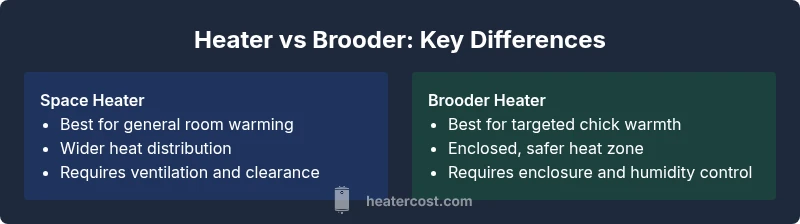
In plain terms, a heater is any device used to raise room temperature, while a brooder is a specialized setup designed to provide controlled heat for young poultry. The main difference between heater and brooder is purpose and heat distribution: heaters warm spaces broadly, brooders focus heat to a small, protected area. Your choice depends on environment and care needs.
What is a heater vs a brooder?
Understanding the terminology is the first step in evaluating the difference between heater and brooder. A heater, in home or workshop contexts, is any device that raises ambient temperature. It can be a space heater, a radiant panel, a compact electric fireplace, or a boiler-based system. A brooder, by contrast, is a specialized setup used primarily in poultry or small-animal husbandry to maintain a stable, localized heat source for young chicks, ducklings, or other newborns. A brooder typically consists of a heat source, a protective enclosure, ventilation strategies, and a means to manage humidity and litter. The Heater Cost team notes that the distinction is not merely semantic: the design intent, operating environment, and safety considerations differ in meaningful ways. When you say 'difference between heater and brooder', you’re really asking about scope (whole-room versus restricted-area heat) and about how temperature is controlled in relation to the occupants. By focusing on how heat is distributed, how responsive the system is to changes, and what safety features are included, you can start to predict energy use, maintenance needs, and risks. This foundational understanding helps homeowners, renters, and property managers avoid common misapplications and select the right approach for homes, barns, and hobby spaces. According to Heater Cost, the distinction is not merely semantic: the design intent, operating environment, and safety considerations differ in meaningful ways.
Core distinctions: performance, safety, and cost
The core differences between a general heater and a dedicated brooder revolve around three pillars: performance, safety, and cost. Performance looks at how heat is distributed and how quickly the device responds to changes in ambient conditions. A space heater disperses warmth across a room, creating gradients of temperature and potentially hot and cool zones. A brooder heater is designed to concentrate heat in a restricted area where newborns will spend most of their time, reducing the risk of drafts or cold spots. Safety is a distinct concern for both, but brooders often incorporate protective enclosures, guard grills, and elevated heat sources to prevent direct contact with litter and young animals, while space heaters emphasize room-level safeguards like tip-over switches and overheat protection. Cost considerations are driven by usage patterns: heating a large living space with a general heater may incur different operating costs than maintaining a controlled microclimate for chicks, even if the initial equipment costs are similar. In practice, homeowners and poultry keepers should analyze expected runtime, climate, and required control precision to estimate overall cost and risk. The Heater Cost team emphasizes planning ahead for seasonal variations and ensuring that any heat source aligns with local safety codes and pet/animal safety guidelines.
Use-case driven guidance: when to choose each
Choosing between a heater and a brooder hinges on the intended use-case and environmental constraints. If your goal is to raise the ambient temperature of a living or working space, a space heater is usually the right tool, offering flexibility across rooms, zones, and different occupancy patterns. When you are rearing chicks or other young animals, a brooder provides more precise control, typically including an enclosure, guards, and humidity management to reduce the risk of burns or exposure to drafts. For mixed-use environments (e.g., a workshop that doubles as a temporary brooding area), consider a modular approach: a general space heater for ambient warmth supplemented by a dedicated brooder in a protected corner with proper ventilation and insulation. Energy considerations favor heat strategies that minimize wasted heat and avoid overheating. In all cases, prioritizing proper clearance, smoke and fire safety, and child/animal safety reduces risk and supports predictable outcomes. The Heater Cost team recommends conducting a pre-purchase assessment that includes room dimensions, expected occupancy patterns, material heat tolerance, and maintenance commitments to drive a better match between device type and application.
Energy efficiency, monitoring, and safety best practices
Energy efficiency hinges on correct sizing and smart controls. When using a space heater, choose models with high energy efficiency ratings, programmable thermostats, and automatic shutoff features to prevent overheating. Regularly inspect cords, outlets, and ventilation to avoid heat buildup near curtains or furniture. For brooders, efficiency comes from proper insulation, a stable enclosure, and precise height-to-heat-source relationships that limit energy waste. Monitoring is essential: check chick behavior, distribution of warmth within the brooder, and litter humidity; adjust the heat source or enclosure as needed. Safety is non-negotiable: never leave heaters running unattended, keep heat sources away from flammable materials, and ensure clear escape routes in case of an emergency. The presence of thermostatic control and sensible zoning is key for both devices to balance comfort, safety, and operating costs. The overarching principle is simple: heat should be present where it is needed, for as long as it is needed, without creating new hazards.
Installation, maintenance, and lifespan considerations
Installation considerations differ substantially between space heaters and brooders. A space heater typically requires no enclosure, but it does demand stable surface placement, adequate clearance, and a powered outlet with surge protection. Brooders require an enclosure or housing that contains heat and protects occupants; this can include a metal guard, a plastic dome, or a dedicated cabinet. Maintenance involves routine cleaning, especially for brooders where litter and humidity can affect heat performance and safety. Periodic replacement of heating elements, inspection of wiring, and ensuring seals and guards remain intact extend lifespan. Lifespan can vary by model and usage intensity; general-purpose space heaters may offer longer lifespans in light-duty scenarios, while brooders are designed for the specific purpose of animal care and may require more frequent checks during peak use periods. Planning for replacement parts and spare components is prudent, particularly for older units or equipment used in humid environments.
How to size and plan: decision framework
A structured sizing approach helps prevent overpaying for hardware or underproviding heat. Start by defining the space: measure the room or enclosure, note insulation quality, and identify heat loss factors such as windows or drafts. Next, determine occupants or heat targets: adult human comfort versus chick warmth needs. Climate matters; in colder regions, more robust heaters may be necessary, while brooders require tighter control to avoid overheating. Then, consider energy sources and installation constraints: electrical capacity, available outlets, and required ventilation. Finally, evaluate safety and maintenance commitments: who will monitor the device, how often will it be inspected, and what safety features are essential for your situation. The decision framework should culminate in a side-by-side evaluation of options, with a clear rationale for choosing one approach over another based on real-world use.
Common misconceptions and clarifications
A prevalent myth is that any heater can substitute for a brooder when rearing poultry. This is false: brooders are designed for narrow heat zones, controlled humidity, and safe enclosure, whereas space heaters are optimized for room-wide warmth. Another misconception is that higher wattage always means better performance; in reality, oversizing increases costs, creates uneven temperatures, and may cause safety concerns. People also assume that professional-grade equipment is always required for small setups; in many cases, a simple, well-designed brood enclosure or a compact space heater with appropriate safety features suffices. Finally, some believe that all heat sources are equally safe around pets and livestock; safety depends on proper placement, enclosure design, and adherence to manufacturer guidelines. Understanding these nuances helps families and farm operations avoid common pitfalls and implement safer, more efficient heating solutions.
Practical sizing guidelines and checklists
- Define the space and occupancy: identify where heat is needed and how many occupants will be present.
- Assess insulation and ventilation: poor insulation increases heating demand; brooders require ventilation to manage humidity and CO2.
- Choose heat source type based on scope: space heater for ambient warmth, brooder for localized warmth.
- Prioritize safety: select units with tip-over protection, guards, and certified electrical components.
- Plan for maintenance: schedule regular inspections and cleaning, especially in humid environments.
- Consider temperature targets: establish stable zones with thermometers placed at chick height for brooders; use room thermometers for space heaters.
- Prepare for energy costs: estimate runtime and ensure controls minimize unnecessary usage.
- Position heat sources properly: maintain safe clearances and avoid heat concentration near bedding or textiles.
- Implement fallback strategies: have a backup heat source and clear shutdown procedures in case of equipment failure.
- Review local codes and safety guidelines: align with manufacturer instructions and veteran best practices for homes and barns.
Comparison
| Feature | Space Heater | Brooder Heater |
|---|---|---|
| Best use case | General room heating for living/working spaces; versatile for spaces of various sizes | Poultry brooding or small-animal care; tightly controlled heat for newborns |
| Temperature control | Thermostats and settings vary by device; can be coarse or fine depending on model | Designed for precise, local temperature zones with proximity-based control |
| Energy source | Electric, propane, gas or oil depending on model | Typically electric; often specialized heating elements |
| Safety features | Overheat protection, tip-over switches, cord management | Heat lamps or brooder plates with guard grates; often integrated heat shield |
| Placement & reach | Can heat entire room; needs clearance from walls and furniture | Placed inside brooders, protected and elevated above litter; requires ventilation |
| Size & footprint | Varies from compact to large units; often portable | Compact, purpose-built units or larger brooders with guard rails |
| Cost range | $20-$300+ for room heaters; price varies by wattage and features | Brooder heaters often $40-$150, plus enclosure costs |
| Lifespan & maintenance | Depends on model; routine maintenance; some require regular element checks | Typically durable; may need replacement of bulbs or heating plates; clean litter and guard rails |
| Best For | General space heating or temporary warming | Poultry brooding and chick rearing environments |
| Common pitfalls | Energy waste, overheating, unsafe placement | Improper sizing, poor ventilation, moisture buildup |
The Good
- Clear identification of purpose and use-case
- Safety features improve reliability when correctly sized
- Potential energy savings with proper sizing
- Wide availability of models and configurations
- Flexible options for different spaces
Negatives
- Misapplication risk if using a heater where a brooder is needed
- Brooders require enclosure and monitoring to maintain chick safety
- Initial setup for brooders can be more complex and costly
- Ongoing maintenance includes cleaning and ventilation considerations
Balanced choice based on context; neither option is universally better.
Choose a heater for broad space heating and versatility. Opt for a brooder when you need tightly controlled warmth for newborn animals. Align selection with space, safety needs, and energy considerations.
Got Questions?
What is the main difference between a heater and a brooder?
The main difference is scope and purpose: a heater warms a space broadly, while a brooder provides a focused heat zone for young animals. This affects installation, safety, and ongoing costs.
The heater warms the room, the brooder warms the young animals specifically. Think of scope and purpose when deciding.
Can a space heater be used as a brooder for chicks?
Using a generic space heater as a substitute for a dedicated brooder is not recommended. Brooders include protective enclosures and controlled heat zones that minimize fire risks and prevent direct contact with litter.
A space heater isn’t ideal for brooding because it isn’t designed to safely confine heat for chicks.
What temperature should a chick brooder be kept at?
A common guideline is to start near 90–95°F (32–35°C) at chick height and gradually reduce the temperature as the chicks grow, while monitoring their activity and feed intake.
Start warm, then gradually cool as chicks grow; always watch the birds for comfort.
What safety features should I look for in these devices?
Look for overheat protection, tip-over switches, guards or barriers around the heat source, and clear ventilation paths to prevent fumes or moisture buildup.
Prioritize devices with automatic shutoff and protective guards for safety.
What factors influence ongoing costs?
Energy usage, device efficiency, climate, and how long the device runs each day influence ongoing costs. Proper sizing and scheduling can significantly reduce expenses.
Smaller, well-sized units run less often and save energy.
Is broodering more expensive than space heating?
Brooder setups can have a higher upfront cost due to enclosure and heat source requirements, but ongoing energy use and maintenance depend on how well the system is sized and used.
Upfront costs for brooders can be higher, but you may save energy with proper sizing.
The Essentials
- Define space vs occupant needs before choosing
- Prioritize proper heat distribution to avoid hotspots
- Factor energy costs and safety features into sizing
- Use a dedicated brooder for hatchling care when needed
- Regular maintenance improves safety and longevity