Water Heater Rheem: Costs, Models, and Installation Guide
Compare Rheem water heater models, costs, and efficiency. This guide covers installation, maintenance, and long-term savings to help homeowners choose the right Rheem system.


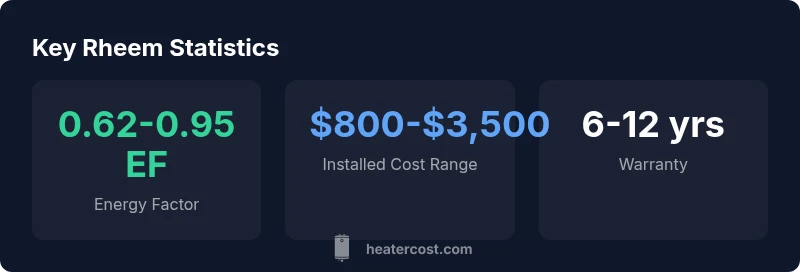
Rheem dominates the U.S. market for residential water heaters, offering a range of tank and tankless models. Typical installed costs for Rheem systems vary by type and capacity, generally ranging from $800 to $2,000 for a standard tank unit, and $1,500 to $3,500 for tankless options, plus installation. Energy efficiency and climate interactions influence long-term savings.
Rheem System Overview
According to Heater Cost, Rheem has long been a leading brand in residential water heating, known for reliability and a broad service network. Rheem offers a diverse lineup, including electric and gas units, conventional storage tanks, and high-efficiency tankless options. The Rheem family also encompasses hybrid heat pump models in select markets. When evaluating Rheem, homeowners should consider installation constraints, energy efficiency ratings, and warranty terms. The brand’s global manufacturing scale generally supports parts availability and service support, which matters for long-term maintenance. In summary, Rheem’s breadth makes it easier to match a system to a home’s hot-water profile, space, and energy goals, though upfront costs will depend on model choice and installation specifics.
Model Options: Tank vs Tankless
Rheem’s tank-based heaters are typically the most affordable upfront and are well-suited for households with predictable hot-water needs or limited space for complex venting. Tankless Rheem models heat water on demand, which can save space and reduce standby energy losses, but may require higher upfront investment and more complex venting or electrical work. For many homes, tank systems provide a simple, reliable baseline, while tankless systems appeal to households seeking higher efficiency, reduced footprint, or greater hot-water flexibility during peak usage. When comparing, look at installed price ranges, fuel type compatibility (gas or electric), and the unit’s maximum flow rate in gallons per minute (GPM).
Sizing and Efficiency Metrics to Consider
Sizing a Rheem water heater involves matching its capacity to the home’s daily hot-water usage. Tank models prioritize first-hour rating (FHR) and recovery speed, while tankless units emphasize flow rate (GPM) at various temperatures. Efficiency is expressed as an energy factor (EF) or uniform energy factor (UEF) for newer Rheem models, with higher values indicating lower energy consumption. In practice, households with high simultaneous hot-water needs benefit from higher-capacity or multiple-unit configurations. Energy-efficient Rheem models can reduce annual energy costs, but the savings depend on usage patterns and climate. A careful assessment of peak-demand periods, family size, and appliance usage helps select a model that balances comfort with operating costs.
Installation Considerations: Permits, Venting, and Labor
Installing a Rheem water heater involves more than selecting the unit. Local permits, venting requirements, and electrical or gas supply upgrades influence total costs and timelines. Tank-style installations may require venting adjustments, expansion tanks, and proper clearance for servicing. Tankless installations often demand more complex vent runs and condensate management, which can raise labor hours and permit needs. The quality of installation directly affects performance and longevity, so obtaining multiple quotes from certified installers is advisable. Always verify that the chosen pro is familiar with Rheem models and local code requirements.
Maintenance and Longevity for Rheem Water Heaters
Regular maintenance helps Rheem systems reach their expected lifespans. For tank heaters, flushing the tank to remove sediment, inspecting anode rods, and checking valve integrity are common tasks. Tankless models benefit from periodic descaling in hard-water areas and annual system checks. Using manufacturer-approved replacement parts and scheduling professional tune-ups every 1–2 years can preserve efficiency and warranty coverage. In regions with hard water, consider a participation-friendly water-softening strategy to protect heat exchangers and extend service life.
Evaluating Total Cost of Ownership
Total cost of ownership for a Rheem system includes purchase price, installation, venting or electrical upgrades, permits, maintenance, and energy costs over the life of the unit. Tank models typically have lower upfront costs but may incur higher standby losses in some climates, while tankless models offer substantial energy savings in the long run but require higher initial investments and potentially more frequent service visits. Geographic variability, utility rates, and household hot-water patterns all influence total cost. Homeowners should run a simple two-budget scenario: one for initial price and one for long-term energy costs, re-evaluated after 5–10 years.
How to Choose an Installer and Get a Quote
Select installers who are familiar with Rheem products and local code requirements. Request itemized quotes that distinguish equipment costs, labor, permits, venting, and any required upgrades (gas lines, electrical service, or ventilation). Ask about warranty handling, emergency service availability, and the installer’s track record with Rheem installations. A good quote should include a brief on-site assessment, confirm correct sizing, and provide an expected timeline from purchase to commissioning.
Typical Rheem water heater options and their install considerations
| Model type | Typical cost range (installed) | Fuel type | Best for |
|---|---|---|---|
| Tank | $800-$1,700 | Gas or Electric | Budget-friendly, reliable hot water |
| Tankless | $1,500-$3,500 | Gas or Electric | Space-saving, high-efficiency goals |
Got Questions?
What is the price range for Rheem water heaters (tank vs tankless)?
Tank models often start around the lower end of the range, while tankless Rheem systems require a higher upfront investment. Total installed costs depend on model choice, fuel type, and local labor rates. Always compare quotes that include installation specifics like venting and permits.
Tank models start lower, while tankless Rheems cost more upfront. Get quotes that include installation details to compare total costs.
How does installation affect Rheem costs?
Installation costs vary with venting complexity, electrical or gas upgrades, and permit requirements. Larger homes or tighter spaces can raise labor hours. Request detailed estimates that separate equipment, labor, and permitting.
Installation varies with venting and upgrades. Ask for detailed quotes itemizing all costs.
What energy efficiency labels should I look for?
Look for the latest Energy Factor (EF) or Uniform Energy Factor (UEF) ratings on Rheem models. Higher values indicate better energy performance. Newer Rheem models often offer improved efficiency with advanced heat exchange technology.
Check the EF or UE rating—higher is better for yearly energy savings.
Do Rheem water heaters come with warranty coverage?
Most Rheem units include a multi-year warranty that varies by model and installation. Verify components like the tank, heat exchanger, and labor coverage in your contract. Warranties are often contingent on professional installation and regular maintenance.
Check what the warranty covers and ensure proper installation and care.
Is Rheem suitable for solar or heat pump integration?
Rheem offers compatible systems and accessories for solar preheat and heat-pump integration in some regions. Compatibility depends on model and local codes. Consult with a Rheem-certified installer to confirm options for your home.
Talk to a pro about solar or heat pump compatibility for your Rheem unit.
How long do Rheem water heaters typically last?
Lifespan varies by model and maintenance, but many Rheem units are designed for 10–15 years with proper service. Regular flushing, anode rod checks, and timely part replacements help maximize longevity.
With regular maintenance, Rheem heaters can last around a decade or more.
“"Rheem models are designed for reliability and retrofit flexibility, but total cost depends on installation specifics."”
The Essentials
- Compare tank vs tankless to fit usage and space
- Obtain multiple quotes to reflect installation complexity
- Prioritize energy factor and warranty terms
- Account for local permits and venting requirements