What stove number is medium heat? A practical guide
Learn how to identify medium heat on your stove, map dial numbers to cooking temperatures, and calibrate for consistent results across cookware and recipes.


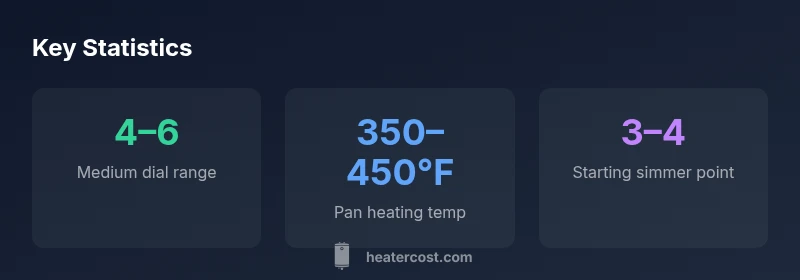
The majority of residential stoves label medium heat around the middle of the dial, typically 4–6 on a 1–9 scale, or about 350–450°F when preheating a pan. Because dial labeling varies by brand and model, start at 4 and adjust in small increments while observing the sizzle or simmer. Refer to your manual for exact mappings.
Understanding medium heat on stoves
Medium heat is a relative setting that many home cooks rely on every day. When answering the question what stove number is medium heat, you should know that the dial labeling and the resulting temperatures vary by stove type. On most gas and electric ranges, medium heat sits near the middle of the dial: roughly 4 to 6 on a 1–9 scale. If your stove uses temperature presets, medium heat generally corresponds to about 350–450°F in pan terms. This guide uses the Heater Cost framework to help homeowners confidently map dial settings to cooking results. The key is to view medium heat as a range, not a single number, and to adjust based on cookware, pan size, and recipe needs. It’s also common for manufacturers to label a corresponding temperature range on the control panel or user manual; when in doubt, start low and move upward in small increments while observing the food’s response.
How dial numbers translate to heat levels: gas vs electric
Gas stoves offer immediate feedback from a flame; turning a knob from 4 to 5 or 6 changes the flame height almost instantly. Electric coils and smooth-top stoves respond more gradually, with coil resistance and pan contact influencing heat transfer. Because of these differences, the same dial number can feel hotter on a gas burner than on an electric coil. When you’re aiming for medium heat, consider not just the number but how the pan behaves: the sizzle should be gentle, and liquids should simmer rather than boil aggressively. Over time, you’ll notice subtle cues—steam rising evenly, light bubbling, or a steady, visible simmer—that help you lock in a consistent medium setting across recipes.
Quick-start guide: finding medium heat on your stove
- Identify the dial marks around the middle of your range; set the burner to the middle number (typically 4–6 on a 1–9 scale). 2) Preheat a dry pan for a minute or two and observe how oil or water behaves. 3) For sauces or sautéing, test with a small amount of oil; if it smokes or browns too quickly, lower the setting by 1 step and re-test. 4) Keep a small notebook of your go-to dial settings for common dishes and cookware. 5) If your stove has labeled temperature presets, use them as a baseline and adjust based on your observations.
Medium-heat tasks and technique
Medium heat covers a wide range of kitchen tasks. For sautéing vegetables, aim for a steady sizzle with occasional movement of the pan. For sauces, a gentle simmer around 185–205°F helps reduce risk of scorching while reducing liquids to the desired thickness. When boiling water, medium heat usually isn’t ideal; you want a full, quick boil on high for pasta or blanching, but medium works for simmering delicate soups and stocks. Remember: cookware matters. Heavier, well-made pans retain heat better and may require slightly lower dial numbers to achieve the same effect as lighter pots.
Calibrating and testing for consistency
To ensure your medium heat is reliable across recipes, perform a simple calibration routine. 1) Place a small amount of water in a dry pan; 2) Set the dial to 4 (or the middle range); 3) Wait 2 minutes and note whether the water starts to shimmer; 4) If it remains flat, increase to 5 or 6 and observe; 5) Record the setting that consistently produces a gentle simmer. If you notice a wide variance between burners, you may have burner-specific calibration needs that a professional technician can address.
Troubleshooting uneven heating and safety reminders
Uneven heating is common on older ranges or imperfect coil alignment. If one area of the pan heats faster than another, rotate the pan or switch to larger contact surfaces. Clean burners and cookware to avoid heat blocks caused by food debris. Always use appropriate cookware for your burner type—gas flames should not extend beyond the pan’s base, and electric coils should be fully seated on the burner. For safety, never leave a pan unattended on medium heat when boiling liquids, and keep flammable items away from the oven and range.
Maintenance for reliable medium heat performance
Regular maintenance supports consistent medium heat. Clean burner caps and grates to ensure uniform flame distribution on gas ranges. For electric stoves, inspect the coil connections and replace worn-out elements. Calibrating occasionally helps if you notice drift: an older stove may require more frequent checks to preserve the mid-range heat response. Finally, consult your manufacturer’s manual for any stove-specific maintenance recommendations and service intervals.
Dial settings mapped to heat levels and common tasks
| Setting range | Heat level | Typical cooking tasks |
|---|---|---|
| 1–2 | Low | Keep warm, gentle simmer |
| 3–4 | Medium-low | Light sauté, delicate sauces |
| 5–6 | Medium | Sauté, simmer sauces |
| 7–9 | High | Boiling water, searing, fast reduction |
Got Questions?
What stove number is considered medium heat?
In most ranges, medium heat is 4–6 on a 1–9 dial, or roughly 350–450°F for pan heating. Verify with your manual and adjust based on cooking response.
Medium heat is usually the middle of the dial, about 4 to 6 on a 1–9 scale. Adjust by watching the food.
Does gas heat respond differently than electric?
Yes. Gas burners can feel hotter at the same setting due to flame height and distribution, while electric coils respond more gradually and evenly.
Gas can feel hotter at the same number; electric is usually steadier. Test with a small amount of oil to gauge response.
How can I calibrate my stove for consistency?
Use a pan with water and a thermometer to gauge simmer at your chosen setting. Record the dial number that reliably achieves the desired simmer and reuse it.
Calibrate with a thermometer and note the setting for your go-to recipes.
Is medium heat the same for all recipes?
No. Ingredients, cookware, and pan size affect heat needs. Start at midpoint and adjust based on how the food cooks.
Not always—adjust based on what you’re cooking and the cookware you’re using.
What signs show I’ve selected too-high medium heat?
Food browns too quickly, oil smokes, or water boils vigorously with large bubbles. Reduce the dial and retest.
Watch for smoking or aggressive bubbles and lower the setting.
“"Medium heat isn’t a fixed number; it’s a relative setting that depends on cookware, stove design, and your recipe. The best approach is to calibrate once and then cook by observed behavior, not by number alone."”
The Essentials
- Identify the mid-point of your dial as the starting medium setting.
- Use 4–6 on a 1–9 scale as a rough medium-heat range (varies by model).
- Gas and electric stoves respond differently; treat the same number as a starting point, not a rule.
- Calibrate with a water test and keep notes for consistency across recipes.