Heater or Fan to Dry Carpet: An Analytical Comparison
Compare heater vs. fan methods for drying carpet, focusing on speed, safety, energy use, and cost. Practical guidance from Heater Cost.


Comparing a heater versus a fan for drying carpet, the fastest results usually come from a targeted heater plus strong air movement and dehumidification. Fans alone reduce safety risk but slow drying, while heat without airflow can scorch fibers. According to Heater Cost analysis, the best balance often uses both tools in a controlled setup.
Why the drying method choice matters
Moisture in carpets can linger for hours or days if not dried properly, leading to mold, odors, and fiber damage. The choice between using a heater versus a fan—and whether to combine both—shapes both the speed and safety of the process. In residential spaces, wrong settings can scorch the fibers or trap moisture beneath the backing. According to Heater Cost analysis, selecting the right approach depends on room size, carpet construction, and the surrounding environment. If you’re dealing with a spill or flood, you’ll want to start with moisture extraction and then progress to drying with controlled heat and airflow. For renters and owners alike, understanding these dynamics helps prevent costly repairs and tenant complaints. The goal is to minimize drying time while protecting the carpet and indoor air quality. As you read, keep in mind that different carpet piles (e.g., loop, cut pile, or boucle) respond differently to heat and direct airflow; thicker pads or dense underlayment retain moisture longer and require longer treatment. The following sections break down the physics, practical setups, and decision criteria to help you choose the most effective method for your scenario.
Drying physics: heat, airflow, and humidity
Drying carpet is really about balancing three factors: heat, air movement, and humidity. Evaporation increases when warm air moves across a damp surface, but the moisture has to escape the indoor space. If humidity remains high, the drying rate slows even with heat. A heater increases air temperature, which raises the vapor pressure at the carpet surface and speeds evaporation. A fan increases air exchange over the carpet, removing moisture-laden air and lowering local humidity relative to the rest of the room. The most efficient approach combines both, often with a dehumidifier running in the background to keep humidity low. From a physics perspective, the dryer the air and the drier the environment, the faster the moisture moves from carpet fibers into room air. The guidance from Heater Cost emphasizes monitoring temperature, avoiding hotspots, and ensuring even airflow to prevent damp spots from forming under furniture or in corners.
Heaters: benefits and risks for carpet drying
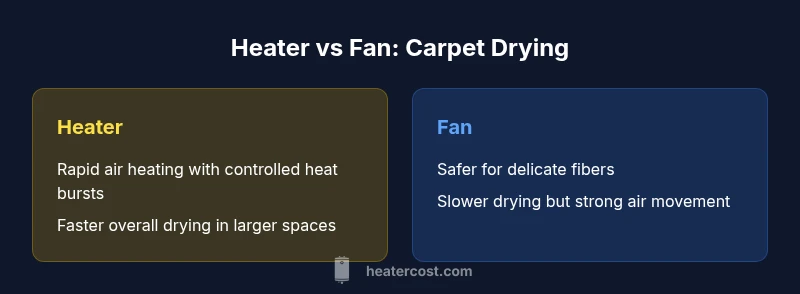
Electric space heaters offer rapid warming of the air around the carpet, which can dramatically accelerate drying in moderate to large rooms. Radiant heaters can heat the carpet surface more directly, but they carry a higher risk of scorching or damaging glue, backing, or delicate fibers if misused. The safest heater approach uses low to moderate heat with steady air movement and plenty of clearance around the heater to prevent contact with rugs, draperies, and furniture. Prefer models with tip-over and overheat protections, and place heat sources on nonflammable mats. Heaters should be used in well-ventilated areas and never left unattended in occupied spaces. Heater-assisted drying is most effective when paired with dehumidification to remove moisture quickly from the air rather than simply warming it. Heater Cost’s guidance recommends running a controlled, short burst of heat combined with airflow rather than continuous high heat.
Fans: benefits and limitations
Fans excel at moving air and expediting evaporation without introducing significant heat. They are safer for delicate carpet fibers and plastic-backed rugs and can be used in tight spaces where large heaters won’t fit. The major limitation is slower evaporation and the potential for uneven drying if air is blocked by furniture or walls. To maximize effectiveness, position multiple fans to create a cross-breeze across the affected area and ensure you have an unobstructed path for moisture to exit the room. Fans work best when humidity is being reduced elsewhere in the space, such as with a dehumidifier. In compact rooms or on heat-sensitive carpets, a fan-only approach often achieves satisfactory results with lower risk of adhesive or fiber damage.
When to pair heater and fan
The pairing of heat and airflow is where most homeowners gain the best balance between speed and safety. Start with a safe, low heat setting and strong air movement, ensuring that the heat source is not directed at the carpet backing. If moisture remains in the air, introduce a dehumidifier to pull water from the room air. This trio—heat, air movement, and dehumidification—reduces drying time substantially and lowers the risk of mold growth. Heater Cost’s analysis shows that the most reliable method for typical living rooms is a calibrated combo: modest heat, high airflow, and active humidity control. Tailor this approach to room size, carpet type, and the presence of padding; large rooms with thick carpets may require longer sessions with intermittent heat bursts. Always monitor progress with a moisture meter and adjust as needed to avoid hotspots.
Setup templates for common scenarios
Scenario A: Small living room with cut-pile carpet. Use one compact space heater on a nonflammable mat, two oscillating fans on opposite sides to create a cross-breeze, and a dehumidifier set to extract moisture efficiently. Check under doors and furniture for air blockers and adjust. Scenario B: Large living area with high moisture from rainfall. Position a heater toward the far corner to warm the air evenly, run several high-velocity fans around the perimeter to push air over the carpet, and place the dehumidifier near the doorway to pull damp air from adjacent spaces. In both scenarios, maintain clearances, avoid cord trip hazards, and never leave equipment unattended. Heater Cost emphasizes starting with conservative heat and expanding as the carpet moisture drops. Monitor progress with a moisture meter and adjust airflow and humidity controls to maintain a steady drying rate.
Cost and energy considerations
Energy use varies with heater wattage, fan speed, and the duration of operation. Heaters typically consume more electricity per hour than fans, and longer run times translate into higher energy costs. The decision to use heat should consider the carpet type, room size, and existing HVAC load. A fan combined with dehumidification often achieves effective drying at lower ongoing energy costs than heating the space aggressively. From Heater Cost’s perspective, the key is not just speed but total energy expenditure, indoor air quality, and risk management. In many cases, a calculated sequence—short heat pulses followed by aggressive air movement and dehumidification—offers the best balance between speed and energy efficiency.
Safety and moisture management: mold risk and detectors
Moisture left in carpets invites mold and odors. Always ensure thorough drying to below the manufacturer’s recommended moisture threshold. Use moisture meters at multiple spots, especially under edges and where furniture sits, to confirm even drying. Smoke, gas, or chemical odors should be checked and addressed before reoccupying the space. Electrical safety is critical: keep power cords organized, avoid water contact with outlets, and use heat sources on stable, nonflammable surfaces. Regularly inspect carpet backing, padding, and seams for signs of moisture damage. Heater Cost suggests integrating humidity control with air movement; this reduces lingering moisture and minimizes mold risk during the drying process.
Real-world checklists and quick-start guide
Create a simple, repeatable checklist for carpet-drying sessions: 1) Remove all standing water and use a wet/dry vacuum where appropriate; 2) Clear the area and set up heat at a safe distance with adequate clearance; 3) Position fans to create cross-ventilation; 4) Start a dehumidifier to maintain low humidity; 5) Check moisture content periodically and adjust heat and airflow; 6) Reassess after a few hours and extend if necessary. This approach keeps you organized and reduces the chance of overheating or incomplete drying. Heater Cost recommends documenting room conditions and performance so you can refine your setup for future spills or floods.
Comparison
| Feature | Heater | Fan |
|---|---|---|
| Drying Speed | Typically faster when used with deliberate airflow and dehumidification | Slower, relies on evaporation rate from moving air |
| Energy Efficiency | Higher energy use per hour; impact depends on duration | Lower energy use per hour; overall cost depends on run time |
| Best For | Large rooms, thick carpets, moisture-heavy spaces | Delicate fibers, small areas, or when heat risk is a concern |
| Safety Considerations | Risk of overheating or scorching if not monitored; clearance needed | Lower heat-related risk but airflow blockage can slow drying |
| Setup Complexity | Requires placement planning, may need dehumidifier | Simpler setup; easier to reposition quickly |
| Noise | Depends on heater type; can be noticeable | Usually quieter, depending on fan model |
The Good
- Accelerates drying with controlled heat and airflow
- Can reduce mold risk when paired with dehumidification
- Versatile in different room layouts and carpet types
- Provides flexibility for various spill sizes and moisture levels
Negatives
- Higher energy costs with heat if run long
- Risk of carpet damage if heat is excessive or airflow is uneven
- Requires careful setup and monitoring to avoid hotspots
- Bulky equipment may be impractical in tight spaces
Combination approach offers the best balance of speed and safety
For most carpet-drying tasks, using a controlled heater along with strong air movement and dehumidification delivers faster results while protecting carpet fibers. In small or delicate spaces, consider starting with a fan and adding heat as moisture declines. Heater Cost's verdict supports a measured, monitored combo for optimal outcomes.
Got Questions?
Can a heater damage carpet when drying?
Yes, excessive heat or direct contact can scorch fibers, soften backing, or warp the carpet. Always maintain clearance, avoid pointing heat directly at the carpet backing, and use heat in short, controlled bursts combined with proper airflow.
Yes. Excessive heat or direct contact can damage carpet fibers. Keep heat away from the rug backing and use controlled bursts with good airflow.
Is a fan alone enough to dry carpet?
Fan-only drying speeds up evaporation by moving air but may not remove moisture quickly enough in larger rooms or thick carpets. Pairing a fan with dehumidification generally provides faster, more even drying.
A fan helps, but in larger rooms or thicker carpets, you’ll usually need dehumidification too.
What temperature should be used when drying carpet with a heater?
Set heat to a low or moderate level and avoid high heat. The goal is to raise room air temperature enough to promote evaporation without overheating the carpet backing or glue.
Keep heat low or moderate and avoid high heat to protect the carpet.
How long does it take to dry carpet with heater or fan?
Drying time varies with room size, carpet type, and moisture level. It typically takes several hours to a full day, especially in high-humidity or larger spaces. Use moisture meters to track progress.
It varies, but expect several hours to a full day depending on conditions.
Can I safely use both heater and fan together?
Yes, with precautions: keep heat sources away from furniture and walls, ensure good clearance, and monitor for hotspots. Use dehumidification to manage humidity and prevent mold growth.
Yes, but monitor for hotspots and ensure safe clearance while using a dehumidifier.
Do dehumidifiers help when drying carpet?
Dehumidifiers accelerate drying by actively removing moisture from room air. They’re especially effective when used with both a heater and fans, reducing overall drying time and mold risk.
Dehumidifiers actively remove moisture and speed up drying when used with heat and airflow.
The Essentials
- Use heat and airflow together for fastest drying
- Dehumidification is essential to speed up moisture removal
- Monitor moisture levels and avoid hotspots
- Choose fan-only in delicate or small-space scenarios
- Safety and airflow planning reduce damage risk