Electric Baseboard Heaters: Costs, Pros, and Practical Guidance
Learn how electric baseboard heaters work, compare costs, sizing, installation, and efficiency strategies with practical guidance from Heater Cost. This guide helps homeowners and property managers optimize comfort and budget.


Electric baseboard heaters transform electrical energy into heat at wall level, using simple resistance coils for convection. They offer straightforward installation, reliable zone heating, and minimal maintenance. However, running costs depend on electricity rates, home insulation, and thermostat use. For homeowners comparing options, understanding wattage, room size, and duty cycles helps estimate comfort and total cost over the heating season.
What are electric baseboard heaters?
Electric baseboard heaters are a simple, wall-mounted form of space heating that converts electricity into heat using resistance coils. They operate by warming the air in an enclosed space along the walls where they’re installed, creating a circulating warm breeze that rises and gently fills a room. Because they are stand-alone units, they offer straightforward installation and intuitive controls. The Heater Cost team notes that these devices excel at zoned heating, letting you target specific rooms rather than warming an entire house. This makes them appealing for older homes, retrofit projects, or rental units where central systems are impractical. While their maintenance needs are minimal, long-term costs hinge on local electricity rates and how efficiently you manage thermostat use. In short, electric baseboard heaters provide dependable, room-by-room warmth with relatively low upfront complexity, but homeowners should plan for ongoing operating expenses that track energy prices. According to Heater Cost, proper placement and sizing are key to maximizing comfort and minimizing waste.
Sizing and load considerations for effective comfort
Sizing electric baseboard heaters begins with understanding a room’s heat load. A common rule of thumb is to match wattage to room size and climate, but exact calculations matter for comfort and cost. Start with a rough target: you need a certain number of watts per square foot, adjusted for insulation, windows, and air leakage. A precise approach uses a room-by-room heat-load calculation or a professional assessment. For homes with challenging drafts or large windows, you may require higher wattage at the perimeter to overcome heat loss. Remember that baseboard heaters heat gradually; selecting slightly higher wattage than a cold-room estimate can reduce cold spots. The Heater Cost analysis emphasizes balancing comfort with potential running costs by using a thermostat strategy that avoids overheating spaces. Strategic zoning matters: heat only occupied areas and use timers or smart controls to prevent energy waste.
Operating costs and efficiency considerations
Operating costs for electric baseboard heaters vary with electricity rates, insulation quality, and how you heat a space over time. They’re most cost-effective when used for targeted zones and when the home is well-insulated. Unlike central heating that can lose efficiency through ducts, baseboard heaters deliver heat directly to the room, minimizing distribution losses. In practice, you should compare electricity prices, consider off-peak rates if available, and use programmable or smart thermostats to maintain steady temperatures without overshooting. The Heater Cost analysis notes that while baseboard heaters can be economical in well-insulated spaces, poorly insulated homes may experience higher running costs. To make informed decisions, use a simple cost calculator that factors wattage, hours of operation, and local energy rates. Consistent thermostat programming and draft-proofing can substantially improve overall efficiency.
Heat distribution and comfort patterns in rooms
Heat distribution with electric baseboard heaters is influenced by placement along exterior walls. Warm air rises from the baseboard unit and circulates, creating a comfortable perimiter warmth. In rooms with high ceilings or large windows, you may notice slightly slower warm-up times or temperature gradients. To improve comfort, space heaters should have unobstructed clearance and be positioned away from furniture or drapes that impede airflow. A well-designed layout uses multiple shorter units rather than a single long run to avoid cold spots and to support more consistent heating. The result is a predictable, zone-based comfort profile that aligns with modern living patterns and energy-conscious habits.
Installation considerations and safety basics
Electrical baseboard heaters typically require a dedicated circuit, with wiring appropriate to the unit’s wattage and your local electrical code. In most homes, that means 120-volt or 240-volt dedicated circuits, installed by a licensed electrician in compliance with safety standards. Clearances from combustibles, furniture, and wall materials must be observed, and tamper-resistant mounting is essential in rental units or households with children. Periodic checks for dust buildup on fins and grilles help maintain airflow and efficiency. If you plan a retrofit, assess your panel capacity, confirm circuit availability, and schedule inspections to prevent overloads. The goal is a safe, reliable installation that supports long-term comfort without compromising electrical safety.
Comparisons with other heating options for rentals and homes
Electric baseboard heaters sit among several heating choices, including forced-air furnaces, heat pumps, and radiant floor systems. Compared with central systems, baseboards offer precise zoning and fewer duct losses but may incur higher running costs in high-rate electricity markets. In cold climates with good insulation, a well-designed baseboard setup can be a cost-effective component of a hybrid system when paired with a heat pump or other primary heat source. For older buildings or rentals, baseboards can minimize disruption and preserve wall integrity during installation. The key is to assess total cost of ownership, including installation, energy use, maintenance, and potential incentives. The Heater Cost guidance reinforces the value of tailoring a solution to your building’s envelope and occupancy patterns.
Thermostats, zoning, and controls to maximize efficiency
Pairing electric baseboard heaters with zone-specific controls amplifies comfort while controlling costs. Programmable thermostats or smart controllers enable you to set schedules for different rooms, ensuring heat only when spaces are used. When possible, integrate occupancy sensing or room-by-room temperature sensors to avoid overheating. If you have a mix of spaces—beds, living areas, and home offices—consider a zoning plan that prioritizes high-traffic rooms. A well-tuned control strategy can significantly reduce energy consumption while maintaining consistent comfort. The Heater Cost team emphasizes testing different programs to find a balance between warmth and energy savings, especially during shoulder seasons when temperatures fluctuate.
Maintenance, lifespan, and typical design considerations
Electric baseboard heaters are low-maintenance devices, typically requiring periodic dusting and grill cleaning to maintain airflow. Their lifespan depends on usage, build quality, and electrical supply stability. While baseboards don’t have moving parts beyond the thermostat and fan (in some models), regular checks help ensure safe operation. Inspect for signs of overheating, unusual smells, or tripped breakers, and replace units that show signs of wear. When assessing long-term investments, consider wattage ratings, replacement costs, and potential upgrades to smarter controls. The Heater Cost analysis notes that proper installation and routine maintenance can extend the useful life of baseboard systems, aligning with budget-conscious homeowners and property managers.
Designing for retrofit, rental properties, and multi-unit buildings
Retrofitting with electric baseboard heaters can be attractive for its simplicity and minimal wall disruption. In multi-unit buildings, consistent zoning and reliable electrical service are key. Evaluate each unit’s envelope, insulation, and window quality to determine whether baseboards will be cost-effective in the long run. For renters, fixed, portable, or easily removable baseboards may offer flexibility without long-term commitments. In all cases, coordinate with local electricians and building codes to ensure compliance and safety. The Heater Cost team highlights that thoughtful placement, adequate circuit capacity, and energy-efficient controls can make baseboard heating a practical, scalable option for diverse living situations.
Key considerations when evaluating electric baseboard heaters
| Aspect | What it Means | Notes for Homeowners |
|---|---|---|
| Heating method | Electrical resistance coils heat air directly near units | Simple technology, easy to install |
| Wattage range | Varies by room size and climate | Consult a load calculation for accuracy |
| Installation requirements | Dedicated circuit, correct clearances | Follow local electrical codes |
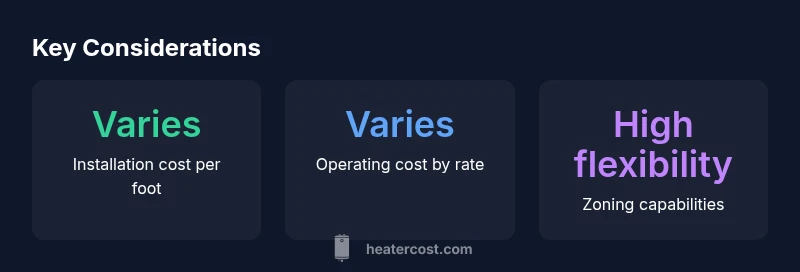
| Cost drivers | Installation, electricity rates, insulation quality | Use an energy calculator for estimates |
Got Questions?
Are electric baseboard heaters expensive to run?
Operating costs depend on electricity rates, insulation, and how you use the heat. In well-insulated spaces, baseboard heaters can be economical when used strategically with programmable controls. In poorly insulated homes, costs rise, so focus on zoning and draft-proofing.
Costs vary with electricity rates and insulation. Use zoning and programmable controls to keep bills down.
Can I install electric baseboard heaters myself?
In many regions, installation must comply with local electrical codes and may require a licensed professional. A dedicated circuit and proper clearances are essential for safety. Always verify permit requirements before starting.
Check local codes and consider a licensed electrician for safety.
How do I size baseboard heaters for a room?
Start with room dimensions, insulation quality, and climate. A load calculation or professional assessment provides accurate wattage targets. Consider higher wattage for drafts or large windows to avoid cold spots.
Do a load calculation to size correctly and prevent cold spots.
Are electric baseboard heaters compatible with smart thermostats?
Many models are compatible with smart thermostats, enabling better scheduling and energy management. Check the product specifications and ensure the thermostat supports heat-only control if needed.
Yes—many work with smart thermostats for better control.
Do baseboard heaters heat up quickly?
Baseboard heaters warm rooms gradually because heat is distributed from the walls. They are less responsive than fan-forced options but provide steady warmth with zoning.
They warm up steadily rather than instantly.
What maintenance is required for electric baseboards?
Light cleaning to remove dust from fins and grilles is usually all that’s needed. Periodic electrical checks and thermostat testing help prevent safety issues over time.
Keep them clean and test the thermostat regularly.
“Electric baseboard heaters offer straightforward zoning and low maintenance, but total cost depends on insulation and electricity prices.”
The Essentials
- Assess insulation before choosing baseboard heat.
- Size equipment based on room load and climate.
- Use zoning to maximize comfort and control costs.
- Pair with programmable thermostats for efficiency.
- Factor electricity rates and potential incentives into total cost.