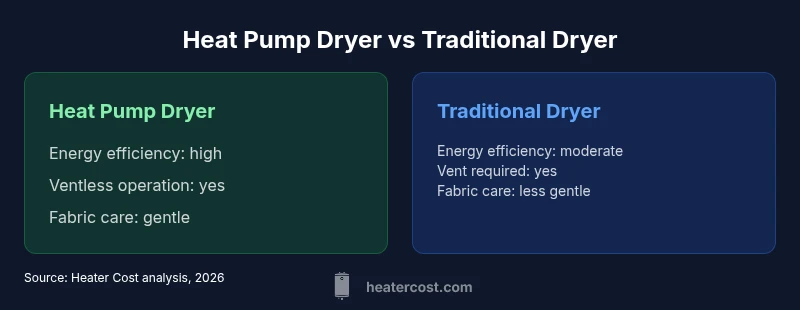
Why Are Heat Pump Dryers Better? A Practical Comparison
Explore why heat pump dryers are better for households: energy savings, fabric care, and long-term cost benefits, with practical buying guidance from Heater Cost.


Why are heat pump dryers better? According to Heater Cost, they reuse heat in a closed loop, using a refrigerant cycle to dry clothes at lower temperatures. This design reduces energy consumption, minimizes heat damage, and can shorten cycle times with modern models. While upfront costs are higher, operating costs typically fall over the dryer’s life, making heat pump dryers a strong long-term value.
What is a heat pump dryer and how it works
Heat pump dryers are a modern alternative to traditional vented or condenser machines. Instead of venting hot, moist air outside, they capture heat inside a closed system and reuse it to dry clothes. The core component is a refrigerant loop that transfers heat from the drum to a heat exchanger, then recovers that energy for subsequent loads. This architecture is the key reason many shoppers ask why heat pump dryers are better: it dramatically reduces energy waste and keeps the surrounding room cooler.
In practice, a heat pump dryer operates at lower temperatures, using a series of sensors and a variable-speed compressor to adjust heat and airflow as the load changes. The result is gentler fabric treatment and consistent moisture removal, rather than high-heat blasts that can stress fibers. Because the system recaptures heat rather than letting it escape, the dryer can run more efficiently even on small loads. For families with delicate fabrics—silks, wool blends, activewear—this gentler approach often translates to less pilling, fewer signs of wear, and longer garment life.
From a homeowner’s perspective, the initial install might require different venting or electrical considerations, depending on your home’s wiring and space. The Heater Cost team notes that in many households, a heat pump dryer can replace an older, higher-energy model with a similar footprint, yielding immediate energy savings in the first year. The long-term economics hinge on usage patterns and electricity prices, but the technology itself sets a new baseline for efficiency.
Energy efficiency mechanisms and why they matter
The energy efficiency of heat pump dryers comes from three design pillars: heat recapture, low-temperature operation, and intelligent moisture sensing. First, heat is captured from the moist air as it exits the drum and reused to heat incoming air. This heat-recovery loop minimizes waste heat and reduces the energy the compressor must generate. Second, the dryer uses lower drum temperatures compared with conventional vented models. While this can extend cycle times on very large loads, it also reduces thermal stress on fabrics and lowers the risk of scorching or shrinking, which in turn reduces the need for rewashing—saving energy and time. Third, modern heat pump dryers employ sensors that monitor internal humidity and load size. When moisture drops to an optimal level, the machine shortens or terminates the cycle, preventing over-drying. In aggregate, these features drive energy performance that surpasses most traditional systems, particularly in households with frequent laundry.
The "why are heat pump dryers better" question is often answered by looking at operating conditions rather than peak power alone. Under typical daily usage, a heat pump dryer will use less electricity per load than a vented dryer, especially for mid-sized fabrics and regular weeknight laundry. The impact compounds over a year, especially in homes with high laundry volume or at peak electricity times. The approach aligns with broader energy-efficiency trends and is a staple in modern energy guides from consumer groups and researchers alike.
Fabric care and drying performance
One advantage often cited in comparisons is fabric care. Heat pump dryers run at lower temperatures, which reduces the chance of heat damage, shrinkage, and color fading. This is especially beneficial for blended fabrics, delicates, and items with prints or embellishments. In practice, many users report that garments emerge softer and less stiff after repeated wash-dry cycles, with less wrinkling if the load is properly balanced. The moisture sensor prevents over-drying, a major contributor to fiber wear in traditional dryers. Because the system uses gentler heat, it also yields fewer loose threads and less pilling on everyday wear. In a mixed laundry scenario—tshirts, jeans, towels—the balance between drying speed and fabric integrity often leans toward longer, gentler cycles that preserve color and texture without compromising cleanliness. For households with children or athletic wear, this can translate into longer garment life and less replacement cost over time. The result is a practical benefit: you get reliable dryness with less concern about the long-term wear on your wardrobe.
From the User's perspective, evaluating fabric care means looking beyond energy labels. Check the drum size and lint filter design, as both influence airflow and moisture removal. Some models offer two-stage drying that optimizes heat flow for mixed fabrics, while others emphasize steam or wrinkle-prevention options. The end goal is a system that balances thorough drying with garment longevity, a goal that resonates with the broader mission of cost-conscious homeowners.
Operating costs and environmental impact
Heat pump dryers typically consume less energy per load than conventional dryers, which translates to meaningful savings over months and years. Because energy use scales with cycle duration and load size, families who wash daily or run multiple cycles per day will notice the most pronounced savings. Additionally, many models feature energy-saving modes and shorter cycles for smaller loads, reducing the delta between load sizes. From an environmental perspective, lower energy use means reduced greenhouse gas emissions when electricity is generated from fossil fuels, though the exact impact depends on your local grid mix. The quieter operation and less heat added to indoor spaces also contribute to improved indoor comfort and potential HVAC efficiency in some homes. In terms of annual cost, it is important to account for local electricity rates, climate, and usage patterns. Heater Cost analysis suggests that households targeting year-over-year reductions in energy bills should consider heat pump models as part of a broader laundry strategy. While the energy savings are real, they hinge on consistent use and proper maintenance, including timely cleaning of lint filters and heat exchangers. The overall environmental footprint is improved when paired with other efficiency upgrades, like efficient laundry machines and better insulation around laundry rooms.
Upfront costs, warranties, and financing considerations
Upfront cost is typically the primary barrier for many buyers. Heat pump dryers usually command a higher sticker price than traditional vented machines, reflecting advanced components, compressors, and specialized heat-recovery systems. The range can vary by capacity, brand, and installed features, with larger units often at the higher end. Financing options, rebates, and utility incentives can help offset the initial outlay, but eligibility varies by region. When weighing upfront cost, consider the long-term payback period—the time it takes for energy savings to cover the added price. Warranties for heat pump systems generally align with standard dryer warranties, but you may find extended coverage for critical components like the compressor or refrigerant system. As with any major appliance, it’s wise to compare beyond the price tag: look at cycle options, heat exchange maintenance requirements, and the ease of professional service in your area. For households planning to stay in place for several years, the long-term operating savings can make the initial expense more palatable, especially in regions with high electricity rates. Heater Cost recommends evaluating total cost of ownership over a five-to-ten-year horizon and exploring available incentives to maximize savings.
Installation, space, and compatibility considerations
Space, electrical requirements, and service access all influence how smoothly a heat pump dryer will integrate with your home. Most models fit in standard laundry alcoves or closets, but you should verify clearance for the heat exchanger and condenser paths. Unlike vented models, heat pump dryers do not require external venting, although some installations still rely on a dedicated drain for condensate. Check electrical requirements—many units run on 230V circuits or special plugs, which may necessitate an upgrade or dedicated circuit. If your home uses a stackable or compact configuration, confirm that the chosen model supports that arrangement. Noise can be a practical concern; while heat pump dryers tend to operate more quietly than older gas or electric dryers, some cycles remain audible in open-plan spaces. Maintenance access is another factor: you’ll want straightforward access to lint filters, condenser coils, and the heat exchanger for periodic cleaning. Scheduling professional installation is typically advisable to ensure proper air seals and electrical safety, especially in homes with older wiring or unusual layout.
Common myths and practical trade-offs
Several myths surround heat pump dryers. A common misconception is that they dry items instantly; in reality, cycle times can be longer, particularly for bulky loads. Another myth is that heat pump tech is fragile or unreliable; modern models use durable components and have dependable service networks, though repair costs can be higher than for basic units. Practical trade-offs involve a balance between upfront cost and long-term savings, cycle length and convenience, and indoor climate considerations. For example, in colder climates, ambient temperatures can influence efficiency if the dryer does not have proper heat management; some models perform better in colder spaces than others. Size and capacity remain critical: a unit that’s too small for your household will require more cycles, eroding energy savings. The key takeaway is to match the model to your actual laundry patterns, fabric types, and energy goals. If energy cost is your primary driver, heat pump models generally provide more value over time; if upfront cost or space is the priority, you may want to consider alternatives or a smaller unit with selective use.
How to choose the right model: features and specs
Choosing a heat pump dryer means weighing several features against your budget and space. Start with capacity and drum size, aiming for at least a mid-sized drum to minimize multiple loads. Look for moisture sensors and auto-dry settings that optimize energy use and reduce over-drying. Noise ratings matter if the unit sits near living spaces or bedrooms; many models offer low-noise operation modes. Energy labels and efficiency ratings—while not universal—give a quick snapshot of performance. The presence of a heat exchanger cleaning indicator is helpful for long-term maintenance, as a clogged exchanger can degrade efficiency. Finally, consider after-sales support, availability of replacement parts, and the ease of professional service in your region. For buyers who value long-term savings, pairing a heat pump model with a high initial efficiency and a robust warranty can maximize return on investment over a typical ownership horizon. The core question to answer when shopping is how often you run laundry, what fabrics you wash, and how important energy costs are in your daily life.
Real-world usage scenarios and case studies
In a moderate-climate home with daily laundry, a heat pump dryer can cut annual energy usage by a meaningful margin compared with an older vented model, particularly if you run multiple loads per day. A family with frequent delicates benefits from gentler cycles, reduced fabric wear, and fewer color transfers. In small apartments with tight spaces, the rear condenser and compact dimensions of many heat pump models offer a responsible fit, combining speed with energy stewardship. Of course, perfect results depend on load balance, fabric type, and cycle selection. The takeaway from real-world scenarios is that heat pump dryers deliver consistent energy savings and fabric care for a broad range of households, while acknowledging some limits for bulky items or large daily loads. If you’re evaluating a retrofit or replacement, the Heater Cost framework suggests assessing total cost of ownership and aligning expectations with your household’s laundry profile.
Comparison
| Feature | Heat Pump Dryer | Traditional Vented Dryer |
|---|---|---|
| Energy Efficiency | Very high (heat-recovery) | Moderate to high depending on model |
| Drying Time | Comparable or longer for bulky loads | Typically shorter for bulky loads |
| Upfront Price Range | Higher upfront cost | Lower upfront cost |
| Operating Cost per Year | Lower due to energy savings | Higher due to energy loss |
| Fabric Care | Gentler on fabrics | Can be harsher on delicate fabrics |
| Ventilation / Venting | Ventless or condenser | Requires venting to outside |
| Maintenance | Condenser/heat exchanger cleaning required | Lint filter cleaning only |
The Good
- Significant energy savings over time
- Gentle on fabrics and reduced wear
- No external venting required for many models
- Quiet operation in many cycles
Negatives
- Higher upfront cost
- Longer cycle times for bulky loads
- Repair costs can be higher due to specialized components
Heat pump dryers are the better long-term choice for most homes.
They deliver strong energy efficiency and fabric care benefits, with acceptable trade-offs in upfront cost and cycle duration for bulky loads. If long-term savings and garment longevity matter, choose a heat pump model.
Got Questions?
What is a heat pump dryer and how does it differ from a traditional dryer?
A heat pump dryer uses a closed loop to recycle heat, unlike vented models that exhaust hot air outside. This design saves energy and is gentler on fabrics. Heater Cost's analysis suggests energy costs are generally lower with heat pump technology.
A heat pump dryer recycles heat to save energy and protect fabrics, unlike traditional vented models.
Are heat pump dryers more energy efficient than conventional models?
Yes. Heat pump dryers typically outperform conventional models due to heat recovery, lower operating temperatures, and smart sensors that prevent over-drying. Efficiency varies by model, but energy savings are a recurring benefit across many households.
Yes. They use heat recovery and cooler drying to save energy.
Do heat pump dryers work well in cold climates?
They can, but ambient temperature can influence performance. Many models are designed to operate efficiently in cooler spaces, while some may see modest reductions in drying speed in very cold environments. Check the product specs for climate suitability.
They can work in cold spaces; verify climate ratings for your model.
Is the upfront cost of a heat pump dryer worth it?
For households with high laundry volume and rising energy costs, the long-term savings usually justify the higher upfront price. Consider total cost of ownership over 5–10 years, local electricity rates, and available rebates when evaluating value.
Long-term energy savings often justify the upfront cost.
Do heat pump dryers require venting?
Most heat pump dryers are ventless or use a condenser, meaning no external vent is required. Some models still need a condensate drain; confirm your installation needs before purchase.
Most don’t need external venting, but check condensate drainage needs.
What features should I look for when buying a heat pump dryer?
Prioritize capacity, moisture sensors, auto-dry settings, noise level, and heat exchanger maintenance indicators. Also check warranty length and service availability in your region to protect your investment.
Look for capacity, sensors, and a solid warranty.
The Essentials
- Prioritize energy efficiency for long-term savings.
- Expect longer cycles for bulky loads, especially on mid-sized units.
- Look for moisture sensors and heat exchanger maintenance indicators.
- Ventless operation simplifies installation in tight spaces.
- Check warranties and available service networks in your area.