What Heating Pad Is Hottest? A Data-Driven Comparison
Learn how to identify the hottest heating pad by heat output, coverage, and safety. This Heater Cost buying guide compares cloth pads, wrap models, and therapy pads for homeowners.


The hottest heating pad for most homes balances fast heat-up, broad coverage, and strong safety features. Compare cloth pads, wrap-style electric pads, and therapy pads to find even heat distribution with reliable auto-shutoff. See our detailed comparison chart.
What 'the hottest' means for heating pads
What does it really mean for a heating pad to be the hottest? The phrase can be misleading, because temperature alone doesn't determine relief or safety. The hottest pad is usually the one that heats up quickly, covers a large area, and maintains a steady, comfortable warmth without overheating. According to Heater Cost analysis, the most relevant trait is heat distribution and control, not simply the top number on a thermostat. For many users, a pad that reaches a high surface temperature in seconds and then sustains even warmth across the target area is more comforting and practical than a pad that briefly spikes to a high reading and then cools. In this section we outline the four criteria that typically separate the hottest practical option from merely the hottest on the box: heat-up speed, uniformity of heat, safety and auto-shutoff, and price/value. We'll compare cloth pad designs, wrap-around electric models, and targeted therapy pads, highlighting how each category performs under real-world use. The goal is to help homeowners choose a pad that delivers meaningful warmth without sacrificing safety or durability, while keeping costs reasonable.
Types of heating pads and how they deliver heat
Heating pads come in several core formats, each with distinct heat delivery profiles. Cloth pads with a plush exterior offer gentle, diffuse warmth and are well suited for long sessions. Wrap-style models, often designed with straps, provide broad coverage over larger areas and can be repositioned easily. Therapy pads focus heat on specific hotspots, such as the lower back or neck, delivering higher localized temperatures. Gel-filled inserts add a portable, reusable element for travel or situational relief. When evaluating the hottest option, consider how quickly each type reaches warmth, how evenly heat spreads toward the edges, and whether the fabric remains comfortable after prolonged use. In general, the fastest heat-up tends to belong to wrap-style and therapy variants, while cloth pads may provide the gentlest, most enduring warmth. Heat distribution matters as much as peak temperature, because even, consistent warmth often delivers better relief with lower risk of contact burns.
Safety features that influence 'hotness' and usability
Safety features are a core part of any heating pad's warmth profile. Auto shutoff timers prevent overheating during extended sessions, while overheat protection sensors detect dangerous temperature rises. Look for fabrics that withstand repeated heating cycles without degrading, and for cords with secure, strain-resistant connections. An important nuance is the difference between models that offer multiple heat levels and those that default to a single high setting. The latter can feel hotter quickly but may be harder to regulate, leading to discomfort or burns. Certification marks from recognized bodies can signal reliable performance. Remember that even the hottest model should be used with a layer of fabric between skin and the pad to reduce direct heat exposure. Heater Cost's evaluation places strong emphasis on genuine safety features and durable construction as essential components of any heating pad considered 'hot'.
Measuring heat output and distribution
Two practical metrics matter when determining which pad feels hottest: heat output and distribution. Heat output is often framed as watts or temperature at the surface, but this is only part of the story. A pad with high wattage but poor distribution can produce very hot centers with cool edges, which feels less comfortable and can be unsafe. A better predictor is uniform heat across a broad surface area, aided by even insulation and well-designed seams. Reviewers should look for consistent warmth across the torso or limb being treated, paying attention to how quickly the pad reaches warmth and whether it maintains heat without requiring constant adjustment. Build quality, including the exterior fabric and the inner lining, influences how heat is retained and released during use. Heavier, densely padded models may feel warmer longer, while light, breathable fabrics can offer higher surface temperatures with quicker cycles. Heater Cost's framework favors models that deliver uniform warmth with sensible control rather than just a high top-end temperature.
Practical scenarios where you want the hottest pad
Different use cases call for different warmth profiles. For broader back relief or full-body-like comfort, a wrap-style pad with high heat capacity and even distribution tends to feel the hottest and most comforting. For localized pain—such as a sore shoulder or cramps—therapy pads or targeted electric wraps can deliver intense warmth to a small area quickly, which some users perceive as the hottest feeling. If you regularly schedule short sessions, cloth pads with rapid heat-up may be easier to manage, while long, steady sessions may benefit from auto shutoff and cool-down cycles that prevent overheating. In all cases, apply a thin insulating layer to the skin and monitor your skin's response to heat. Heater Cost's analysis suggests starting with a moderate setting and gradually increasing while ensuring safety features are active.
Price, warranties, and longevity considerations
Cost is a major factor when deciding which heating pad feels the hottest while keeping value in sight. Cloth pads are typically the most affordable option, with a broad range of inexpensive models. Wrap-style pads tend to sit in the mid-range, offering good coverage and adjustable fit without premium pricing. Therapy pads can vary widely in price, often reflecting targeted design and higher-quality materials. Across all formats, warranties provide a signal of confidence in durability; longer warranty periods generally correlate with better build quality. When budgeting, consider not only the upfront price but also potential replacement costs, energy use over time, and the ease of cleaning or machine washing. In the end, the hottest pad should be one you can rely on for many cycles without significant upgrade costs. Heater Cost recommends considering total cost of ownership alongside initial price.
Materials, comfort, and heat retention
The inner materials and outer fabrics influence both perceived heat and comfort. Dense, well-insulated cores preserve warmth after power is removed, while plush, breathable fabrics prevent overheating on contact with skin. Some pads use cotton blends, fleece, or micro-plush covers that feel warmer and help distribute heat more evenly. Edges and seams can be a nuisance if they trap heat unevenly, creating hotter zones or cooler zones along the border. In addition, the pad's weight can affect heat retention: heavier models tend to stay warm longer, while lighter versions heat up more quickly but may feel less intense over extended sessions. When evaluating the hottest option, prioritize materials that stay comfortable for your skin's sensitivity, and that withstand repeated washing and drying cycles without shedding fibers or losing shape. Heater Cost's methodology favors pads with soft, durable covers and reliable heat maintenance over time.
How to read reviews and Heater Cost's review criteria
Reviews are most helpful when they reveal how heat behaves in real life, not just in a lab. We focus on three core questions: does the pad heat quickly and stay warm, is heat distributed evenly across the target area, and how safe is the model with everyday use? We also assess practical aspects like ease of cleaning, ease of use, cord management, and the durability of the cover. A good heating pad review should note any edge heating issues, potential hot spots, or odor during first-use. We also consider warranty length, return policy, and the availability of spare parts or cover replacements. Based on Heater Cost's evaluation framework, the best-aligned options deliver consistent warmth, straightforward controls, and a reliable safety profile across different body areas.
Framework for choosing the hottest pad: a decision guide
To choose the heating pad that feels hottest in a safe, sustainable way, start by listing your top priorities: fast heat-up, wide coverage, or precise targeting. Then compare models across heat-up speed, distribution quality, safety features, and price. Use our comparison table to see how each option stacks up on these criteria, and check for certifications and warranty coverage. Finally, balance perceived heat with skin comfort and long-term durability, since the hottest feeling is not always the most reliable or healthiest choice. The Heater Cost team emphasizes a holistic approach: prioritize safety, verify build quality, and choose a model that offers value and ease of use for your home environment.
Feature Comparison
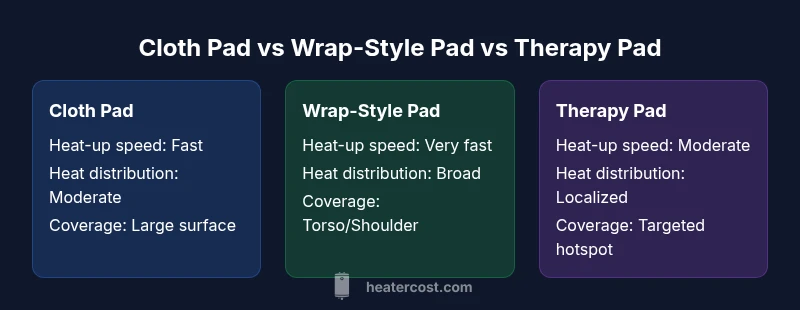
| Feature | Cloth pad | Wrap-style electric pad | Therapy pad |
|---|---|---|---|
| Heat-up speed | Fast heat-up | Very fast heat-up | Moderate heat-up |
| Heat distribution | Even across large surface | Broad wrap coverage with edge tolerance | Localized heat zones |
| Adjustability | Multiple heat levels and timers | Multiple heat levels and straps | Limited to basic settings |
| Typical coverage area | Large rectangular area | Torso/shoulder wrap coverage | Targeted hotspot only |
| Safety features | Auto shutoff, overheat protection | Auto shutoff, overheat protection, cord management | Auto shutoff (varies by model) |
| Price range (USD) | $20-$60 | $40-$90 | $25-$70 |
| Best for | General relief and long sessions | Wide-area relief and mobility | Focused heat with quick relief |
The Good
- Fast relief with broad coverage
- Multiple formats to fit different needs
- Multiple heat levels for customization
- Relatively affordable options across budgets
- Balanced safety features across models
Negatives
- Risk of overheating if left unattended
- Durability varies by material and construction
- Wrap-style pads can heat edges less evenly
- Some budget models lack robust auto shutoff or cords
Wrap-style electric pads generally offer the best balance of heat coverage and safety features
If you value broad warmth and convenience, choose wrap models with auto shutoff. For targeted relief on a specific area, therapy pads can feel hotter but may sacrifice uniformity.
Got Questions?
What makes a heating pad feel the hottest?
Hottest feel comes from a combination of fast heat-up, broad and even heat distribution, and strong safety features. A pad that gets warm quickly but distributes heat evenly over a large area tends to feel hotter and more relieving without risking burns.
The hottest pad feels warm fast, covers a wide area evenly, and has solid safety controls.
Are wrap-style pads hotter than traditional cloth pads?
Generally yes for heat delivery because wrap-style designs bring heat to a larger area more quickly. Cloth pads tend to feel gentler and slower to heat. The trade-off is often edge heat vs uniform warmth across the target zone.
Wrap styles heat a larger area faster, but cloth pads are gentler and more even over time.
How can I safely use a hot heating pad for long sessions?
Always use a fabric barrier between skin and pad, set the lowest comfortable heat, and rely on automatic shutoff if available. Monitor skin periodically for redness or burn-like sensations, and give your skin breaks between sessions.
Start with a low setting and use the timer; check your skin regularly.
Do therapy pads count as the hottest options?
Therapy pads can feel hotter in targeted zones due to focused heat, but they may not provide the same uniform warmth as wrap-style pads. They’re great for pinpoint relief but can be less forgiving for general use.
Therapy pads heat targeted areas more intensely but may not feel evenly warm across a large area.
What else should I consider besides heat when choosing the hottest pad?
Consider safety features, ease of cleaning, durability, warranty length, and overall comfort. A pad that feels hottest initially might be less reliable over time or harder to maintain.
Think safety, durability, and ease of care along with heat when choosing.
What is a realistic price range for high-quality hottest pads?
Prices vary by type and features, with cloth pads tending to be cheaper and wrap/therapy models in the mid-range. Expect roughly a few tens of dollars difference depending on the features and brand.
Expect modest differences based on features and build quality; look for value and warranty.
The Essentials
- Compare heat-up speed across models
- Evaluate durability and fabric quality for long-term use
- Balance heat output with price and warranty coverage
- Prioritize auto-shutoff and overheat protection