MR Heater Garage Heater: Costs, Installation & Efficiency
A data-driven guide to MR Heater garage heater costs, sizing, installation, and maintenance for homeowners, renters, and property managers, with insights from Heater Cost.


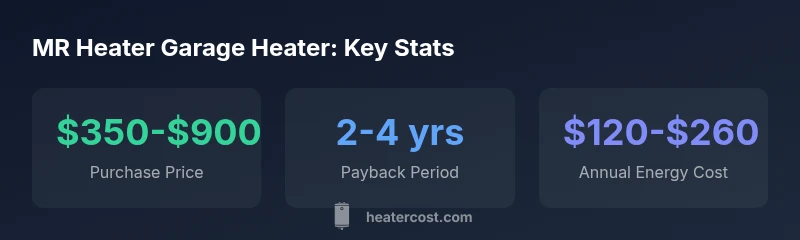
MR Heater garage heater offers a practical heating solution for attached and detached garages, delivering steady warmth with straightforward installation. Quick data point: total cost of ownership typically includes purchase, installation, and annual fuel or electricity costs, with a typical payback period of 2-4 years in moderate climates. According to Heater Cost, choosing proper sizing and clearance is crucial for safety and efficiency.
What is a MR Heater garage heater?
A mr heater garage heater is a compact, gas-fired or electric space heater designed to heat garages, shops, and utility spaces. It is typically intended for zone heating, meaning it warms a specific area rather than the entire home. Most MR Heater garage heaters come in vented and vent-free configurations, with models that are portable or wall-mounted. These units are popular among homeowners and renters who want fast, targeted warmth during cold months without remodeling a whole-house system. When evaluating a mr heater garage heater, consider fuel type, heater output, safety features, and installation requirements. According to Heater Cost, these heaters can be cost-effective for moderate climates when sized correctly and installed with proper clearances.
- Pros: fast heat, adjustable output, can be installed in a variety of garages.
- Cons: require proper ventilation for gas models, CO detectors are essential.
- Common use cases: detached garages, workshops, basements with garages, and uninsulated bays.
How MR Heater garage heaters work
MR Heater garage heaters operate by burning gas (propane or natural gas) or using electric resistance elements to produce heat. A built-in blower helps distribute warm air, while a thermostat maintains a target temperature. Vent-free gas models rely on ambient air for combustion; vented models expel exhaust through a venting system. Safety features often include an automatic shutoff, oxygen depletion sensors, and built-in CO detectors. Proper sizing ensures the unit meets the space’s heating demand without overworking the burner, which improves efficiency and longevity. Regular venting checks (if applicable) and clean air intake help sustain performance over time.
- Key components: burner, heat exchanger, blower, thermostat, safety shutoff, CO sensor.
- Important: install according to local codes and manufacturer instructions to avoid gas leaks or carbon monoxide risks.
- Heater Cost insight: gas models require venting only when necessary and benefit from insulation and door seals to maximize effectiveness.
Cost considerations and ownership
Owning a MR Heater garage heater involves upfront purchase costs, installation (professional versus DIY), and ongoing energy expenses. The total ownership cost depends on the heater’s BTU rating, fuel type, climate, and insulation level in the garage. While higher-output units heat faster, they may consume more fuel or electricity if not properly sized or controlled. For many homeowners, a mid-range unit paired with a programmable thermostat yields the best balance of comfort and cost. Heater Cost analysis in 2026 emphasizes that while initial costs can vary, long-term savings stem from efficient operation, reduced idle heat loss, and improved garage usability. Consider incentives or rebates where available and factor in potential insulation upgrades to improve payback timelines.
- Sizing matters: a correctly sized unit avoids oversizing that wastes fuel.
- Insulation helps: sealing gaps and adding weather stripping can reduce heat loss dramatically.
- Quick ROI: improved comfort during peak cold periods often justifies the investment.
Sizing, placement, and safety guidelines
Correct sizing and placement are critical for both performance and safety. Start by calculating the garage volume (length × width × height) and compare with the heater’s BTU rating. A hotter space isn’t always better; oversizing can lead to short cycling and increased wear. Place the unit away from flammable materials and ensure adequate clearance from walls, ceiling fixtures, and vehicles. Install CO detectors and, for gas models, ensure proper venting or combustion air supply as recommended by the manufacturer. In climate zones with high cold exposure, consider a two-zone approach or supplemental insulation to maximize effectiveness. Heater Cost notes that professional installation may be prudent for gas models to ensure safe gas connections and venting compliance.
- 3-4 feet of clearance is a typical minimum around the unit.
- CO detectors should be installed near the heater and in the living area if the garage opens into the home.
- Regular inspection of gas lines and venting is essential for safety and performance.
Installation steps and timeline
A typical installation involves a short planning phase, followed by mounting (for wall-mounted models) or uncovering a portable unit, connecting the fuel source, and performing a safety check. If gas lines or venting are involved, a licensed installer is strongly recommended to comply with local codes and insurance requirements. Expect a few hours for a wall-mounted installation and potentially longer if venting modifications are required. After installation, run the unit at low heat to check for leaks, proper ignition, and thermostat responsiveness. Record readings and keep a log of maintenance tasks.
- Step 1: verify space and required clearances.
- Step 2: install mounting bracket or secure the unit.
- Step 3: connect fuel or electrical supply and test ignition.
- Step 4: install CO detector and test safety controls.
- Step 5: monitor initial performance and adjust thermostat settings.
Maintenance, warranties, and common issues
Regular maintenance helps extend the life of a MR Heater garage heater and preserves efficiency. For gas units, schedule annual professional inspections of gas lines, burners, and venting. Clean or replace air filters on electric models as recommended by the manufacturer. Check CO detectors regularly and replace batteries as needed. Typical warranties cover parts and sometimes labor for a defined period; review the specifics for your model. Common issues include uneven heating, ignition problems, and thermostat drift, often resolved with cleaning, adjusting venting, or recalibrating the thermostat. Keeping the unit clean and ensuring proper clearances reduces the likelihood of heat damage or fire hazards.
ROI and long-term value
Over time, a MR Heater garage heater can provide meaningful warmth for working spaces, potentially improving productivity and comfort. When evaluating ROI, consider not only the purchase price but also installation costs, fuel or electricity prices, and the garage’s insulation quality. A well-insulated space with proper sealing often yields more favorable payback. Heater Cost analysis highlights that owners who pair their heater with smart thermostats or programmable controls tend to enjoy better energy management and consistent comfort, particularly in harsher winter climates. As with any investment, compare total cost of ownership across multiple models and consider upgrades to insulation or air sealing to maximize value.
Cost and maintenance snapshot for MR Heater garage heater
| Aspect | Low | Mid | High | Notes |
|---|---|---|---|---|
| Purchase price | $350 | $600 | $900 | Prices vary by model and region |
| Installation cost | $150 | $350 | $700 | Labor rates and materials |
| Annual energy cost | $120 | $240 | $360 | Assumes typical usage |
| Replacement interval | 5-15 years | - | - | Depends on maintenance and usage |
Got Questions?
Is a MR Heater garage heater safe for attached garages?
Yes, many MR Heater garage heater models are designed for attached garages when installed with proper venting (for gas models) and CO detectors. Always follow manufacturer instructions and local code requirements. Have a licensed professional verify gas connections and ventilation if you’re unsure.
Yes, but you should follow safety rules and use CO detectors in the garage.
What size (BTU) do I need for my garage?
Sizing depends on garage volume, insulation, door drafts, and climate. A general rule of thumb is to select a unit whose BTU rating matches the space, avoiding oversized or undersized units. Use an official sizing calculator or consult a heating professional for precise results.
Measure your space and use a sizing calculator for the right BTU.
Can I install it myself, or should I hire a professional?
For electric models, DIY installation is common if you’re comfortable with electrical work. Gas models typically require a licensed installer due to gas lines and venting. Always check local codes and warranty terms before proceeding.
Gas models should usually be installed by a professional.
Do MR Heaters require venting or CO detectors?
Gas models may require venting depending on the model and installation. CO detectors are strongly recommended or required by code in many areas, especially for enclosed spaces like garages. Electric models typically don’t require venting but should still have CO detectors if used near living spaces.
CO detectors and venting considerations are important for gas models.
How can I estimate operating costs?
Operating costs depend on fuel type, local energy prices, and how often the heater runs. Using a programmable thermostat and temperature setbacks can reduce energy use. Heater Cost analysis suggests comparing seasonal usage across models to estimate annual costs more accurately.
Check energy costs and use a programmable thermostat to save.
What maintenance is essential for longevity?
Regularly inspect gas connections, clean air intakes, and replace filters on electric models. Test safety features (thermostat, CO detectors) and schedule annual professional checkups for gas units. Proper maintenance helps prevent outages and extends the heater’s life.
Keep it clean, test safety features, and schedule annual checks.
“When installed correctly, a MR Heater garage heater can provide reliable zone heating for workshops and garages, especially when paired with proper insulation and CO monitoring.”
The Essentials
- Assess total costs before buying
- Size unit to garage area and insulation
- Prioritize safety clearances and CO detectors
- Consider professional installation for gas models
- Regular maintenance extends life and efficiency